


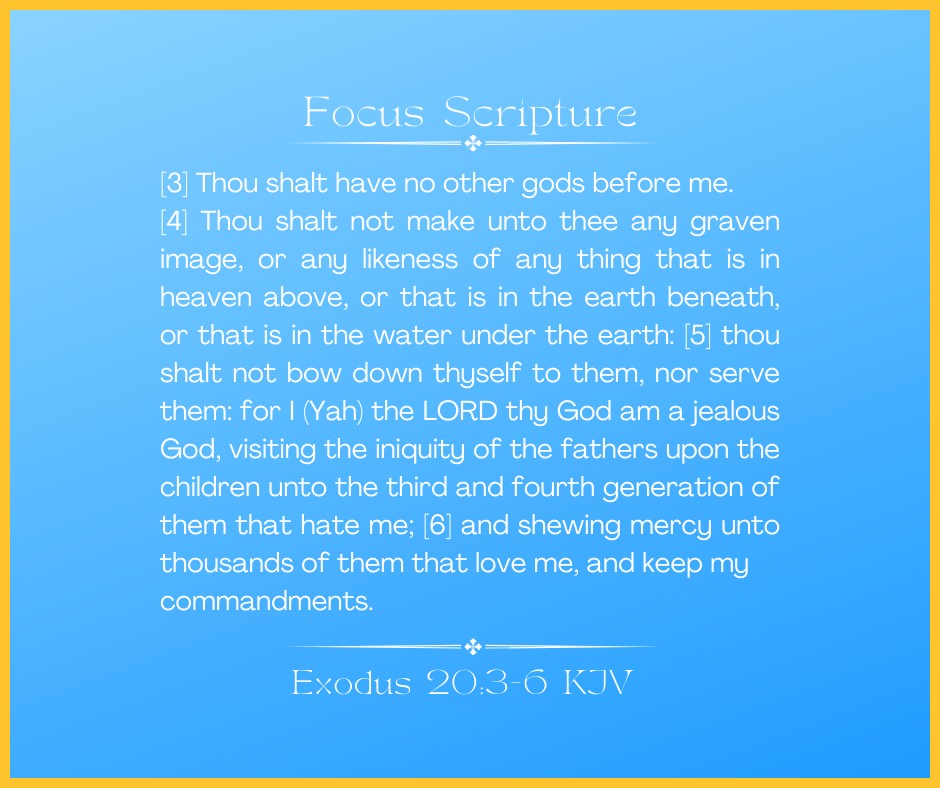
Hello everyone! In the previous blog, we discussed Exodus 32, where it gave us a firsthand account of the Israelites straying away from the Most High and being led into idolatry. We also discussed the first three types of idolatry: entertainment, social media, and self. If you have not read Part 1, I would highly suggest that you start there before proceeding with this week’s topic.
6 Types of Idolatry
- Entertainment (Apr. 30th)
- “Living a life driven by fun and being entertained”
- Social Media (Apr. 30th)
- “Living for the likes and shares of others”
- Self (Apr. 30th)
- “Living a life full of yourself”
- Relational
- “Living a life entangled in idolatrous relationships”
- Organizational
- “Living a life joined together with idolatrous organizations”
- Religious
- “Living with blind allegiance to a church, denomination, or leader”
Relational Idolatry

The fourth type of idolatry is relational idolatry. Within this area, we will focus on three types of relationships: romantic, familial, and friendship. In addition to these types, we’ll discuss our relationship with food, money, alcohol and drugs. Within romantic relationships, idolatry can show up when we idolize marriage or our spouse. Marriage can turn into an idol when those who are single or in a courtship become obsessed with getting married or the thought of being married. They live with the mindset that marriage is the totality of their existence. Marriage is a beautiful covenant designed by God between a man and a woman; and, it is great to desire to be married. But that desire can become unhealthy and idolatrous when our entire life and existence revolves around it.
We can not live consumed with the thoughts of: Will I ever get married? Who will I marry? When will I meet my future spouse? Will God send me my spouse? How long will it be before I get married? When this becomes our frame of mind, our consistent way of thinking, marriage has turned into an idol. And likewise, for married couples, you can make your spouse an idol when you are wrapped up in every part of the person, and your entire existence revolves them. At this point, you have taken God off the throne and made your spouse your god. You should prioritize your marriage and household. It is important to be fully invested in your marital union, pouring into your spouse, ensuring that you have a healthy and thriving marriage. But your spouse should never be your everything; only God should be that in your life.
If we have moved God from being our everything and substituted Him with a counterfeit, we are walking in idolatry. Regardless of your responsibilities to your spouse and household, you can not afford to neglect your relationship with Yah. Time with the Father is still necessary no matter your relationship status. It may look different than before, but nonetheless, it still should be your priority. If there is any infatuation or obsession within the relationship that is a recipe for disaster, and we are simply waiting for the consequences of our idolatry to manifest. It is vital that we have Godly order and balance in our relationships. If there is anything out of alignment, we can ask the Holy Spirit to help us restore the proper relationship dynamic. It will guarantee that we are no longer making marriage and our spouse, an idol.
The next area in relational idolatry is familial relationships. It is possible to make our family an idol. We know that caring for our family and managing our household is a priority. We are expected to do so. But we can find ourselves idolizing family members completely unaware of how it is affecting the family dynamic. Parents do so when they put their child(ren) on a pedestal, thinking they can do no wrong. They make allowances for the areas that need to be corrected. In withholding correction, they allow their children to be out of order. They attempt to befriend their children instead of being a parent, providing the instruction their children need. Or, they can show overt favoritism of one child over another.
In a family with multiple children, siblings are fully aware that some or one is the parent’s favorite. The exalting of one child over another causes strife and division. This is damaging to the family unit and can have long-lasting consequences. We can’t forget Jacob’s favoritism of Joseph and how it negatively affected the relationship dynamic between the siblings. Yes, if you’ve read the story, everything turned out well in the end for Joseph and his brothers. But this is a primary example showing how favoritism causes a breakdown in familial relationships and should be avoided at all costs. In understanding the possible repercussions for idolatry, we should be mindful not to put others on a pedestal.
The third area of relational idolatry is our friendships. We can fall into friendship idolatry when we put all our energy and effort into friendships while neglecting our relationship with God. Yes, it is important to cultivate and maintain Godly friendships, but we should not do so at the expense of putting God on the back burner in our lives. When we have free time, we should prioritize time with Him and study His Word. We can not spend all our free time with friends and never dedicate time to Yah. We must have our priorities in order when it comes to our relationships so they do not become idols.
Outside of our relationships with people, we can have idolatrous relationships with other things in our lives. I want to focus on our relationships with food, money, alcohol and drugs. I know you may think that these areas can’t be an idol. But they have the ability to be one when we have extreme love for it. It becomes insatiable. It gets to a point in our lives where the particular thing is used as a place of comfort or a way of escape.
Our relationship with food can become an idol when we are driven by hunger, and our hunger pangs dictate our lives. There comes a time when we need to turn down our plate and fast for a meal or two, or even a longer duration of time. Do we give in to our flesh rather than telling our body, no? Do we allow our stomach to control us rather than controlling it? If we have become gluttonous, excessively indulging, food is now an idol. When we eat to provide comfort rather than for natural sustenance, it develops into an idol. Whenever food becomes a crutch, what we use to get through something or as a way of escape it leads to idolatry. As believers filled with the Holy Spirit, we need to make the decision to exercise self-control and tell our body no. We must rule over our flesh, not allow it to rule over us.
Next, our relationship with money can be an idol. If we find ourselves wrapped up in the love of money, it has turned into an idol. The Word tells us that the love of money is the root of all evil. Money itself is not evil. However, when our affection is attached to it, it is. We should be good stewards of what we have not becoming greedy, money hungry, and driven by wanting more and more.
It is important to pose questions to recognize where our heart posture is towards money. When we give the Holy Spirit access, He will reveal it. Some questions to ask are–With what I have or hope to obtain, what will I use it for? Is it to ensure my family and household needs are met? Do I look for an opportunity to be a blessing to others? When I have the funds to help someone else, do I tightly hold on to “my” money and turn a blind eye to their needs? Do I put some money aside for a much needed vacation? Or, is it all for selfish reasons, looking out for myself only? We must ask those questions to identify any areas where our relationship with money has grown into idolatry. With the help of the Holy Spirit, we are able to renew our mind from our old way of thinking and living no longer bound to the idol of money.
The last two areas are alcohol and drugs. They can develop into a way of coping and finding peace outside of God. When we have to self-medicate with alcohol and drugs to find peace, or if we use it as an escape, it has become an idol. No matter what we are facing, the comfort and peace we need is found in God alone. With alcohol and drugs, it may give temporary satisfaction or pleasure that keeps you coming back. But you will never find true fulfillment in it. This satisfaction outside of God has consequences that are both short-term and long-term. The only true satisfaction that we can obtain is through Jesus Christ, not from any other source. Everything else is a counterfeit that takes from you more than it gives.
Organizational Idolatry
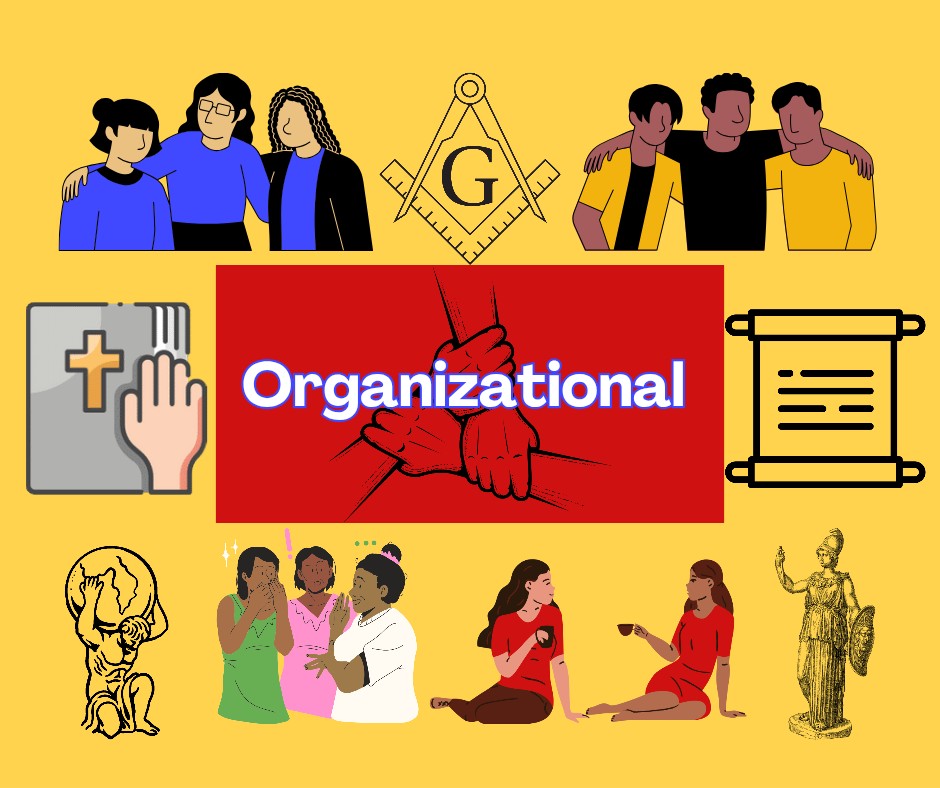
The fifth type of idolatry is organizational idolatry. This type is commonly overlooked. In this area, I want us to consider the following organizations: Freemasonry, the Order of the Eastern Star, Fraternities, and Sororities. When we examine any organization from a surface level, we may not see the idolatry that is lurking beneath. Generally speaking , we may be familiar with the impact these groups have in society and their contributions in service or monetarily to the communities around them. Nevertheless as believers, we have to be mindful of who and what we join ourselves to. The scripture that is befitting is 2 Corinthians 6:14-18:
‘Be ye not unequally yoked together with unbelievers: for what fellowship hath righteousness with unrighteousness? and what communion hath light with darkness? And what concord hath Christ with Belial? or what part hath he that believeth with an infidel? And what agreement hath the temple of God with idols? for ye are the temple of the living God; as God hath said, I will dwell in them, and walk in them ; and I will be their God, and they shall be my people. Wherefore Come out from among them, and be ye separate, saith the Lord, And touch not the unclean thing ; And I will receive you, And will be a Father unto you, And ye shall be my sons and daughters, saith the Lord Almighty.’
We should not be attached to anything or anyone that will cause our hearts to be divided from the Most High. Personally, I have witnessed particular organizations openly embraced, welcomed, and celebrated within the church from the Eastern Stars to fraternities and sororities even though they have beliefs, customs, and rituals that are contrary to the Word. I have no previous or present affiliation with any of these groups. I simply want to inform others to be careful of what they attach themselves to. It is my hope to shine a light in areas that may be otherwise glossed over.
As believers, we need to know who we are yoked together with. The oaths, pledges, and rituals performed in these organizations have joined together believers and unbelievers. From my research and hearing of others’ testimonies, every member within the organization is not of the same faith. There is a clear mixture of light and darkness. The Word clearly instructs us not to be yoked together with unbelievers. We can not turn a blind eye to that instruction. It is not a suggestion but a requirement. As a believer, there are associations and affiliations we should not have with those who are unbelievers.
We have to ask ourselves how can we consider connecting with individuals who don’t serve or believe in the same God as us. How can we consider someone our brother or sister when he or she belongs to another faith? There is a difference in witnessing to unbelievers and sharing the Gospel of Jesus Christ. That is necessary. But this consists of merging righteousness and unrighteousness. How can two people walk together unless they agree? No matter the commonality of the organization, one is walking in light, and the other is in darkness.
In addition to the mixture of believers and unbelievers, we have to consider the oaths, pledges, and rituals that are at the core of the organizations. For those who are a part of these organizations, it is important to evaluate what you have come into agreement with. During the induction process and throughout your time as a member, have you participated in activities that would be displeasing to God? For those who are saved, we are in covenant with Yah. We can not be in covenant with God and with an organization at the same time. That is idolatry; we can only serve God alone. You can not commit yourself and life to an organization while simultaneously claiming to be saved and serving God. You must ask yourself: Is there anything that is said or done that is contrary to the Word of God?
Are there any rituals performed that have spiritually joined you with the organization? Does the organization promote a lifestyle of righteousness or unrighteousness? Does the outside image look morally correct, but what is hidden beneath is full of immorality? Is there anything hidden that can not be discussed with outsiders that is perceived as idol worship? Have you bowed down at an altar and spiritually tied yourself to the organization?
These are just some things to take into consideration. It is my hope that you further look into these organizations that generally have been accepted without knowing what is at the root of it. I have attached resources to further look into them for your own personal research.
Resources to learn more:
- http://www.emfj.org/
- https://www.outfromamongthem.com/
- Idolatry in Greek Fraternities & Sororities – Fred Price Jr: https://youtu.be/AaSvOiWr15M?si=-DZ2CDW2XsNAlnGe
- Sr. Pastor Eric W. Davis: The Idolatry Behind Secret Societies: https://youtu.be/UxgULhrngzc?si=CWRKgX43LTRDMo7J
Religious Idolatry
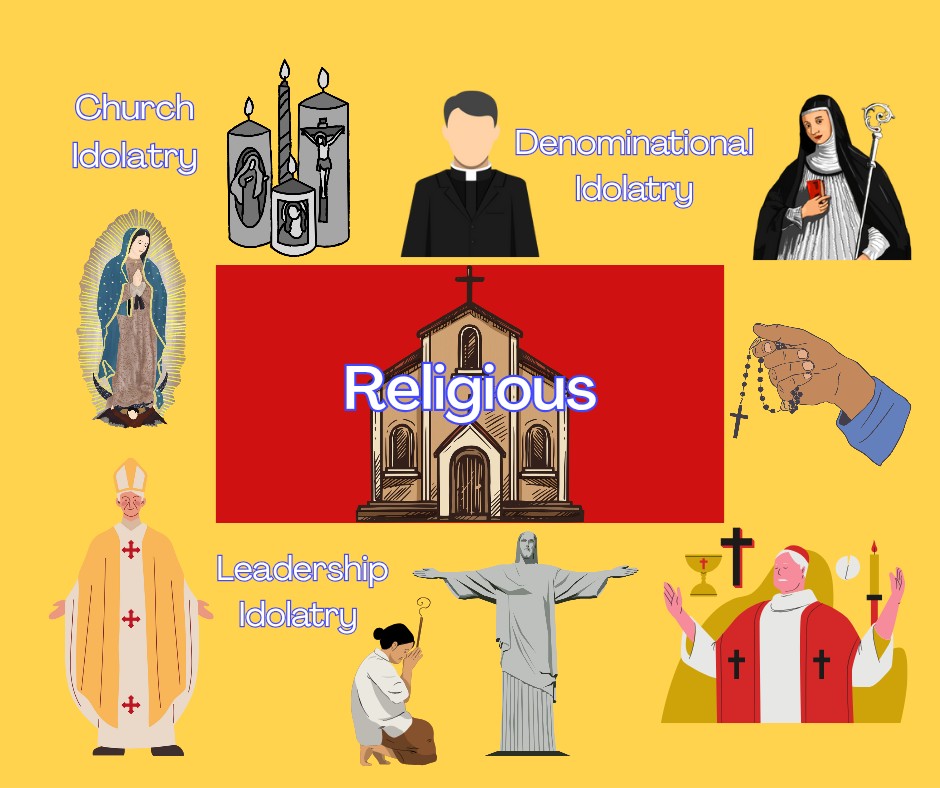
The sixth and final type of idolatry is religious idolatry. This area can be sneaky, and we may be unaware that we are walking in it. I have broken it down into leadership, church, and denominational idolatry. If we do not stay vigilant, we can find ourselves in blind allegiance in all three areas. We should never be willing to blindly pledge our loyalty or commitment to a leader, church, or denomination without fully examining what they believe. It is important to know the belief system of what or who you are submitting to. We should assess if it is in alignment with the Word.
The first area is leadership idolatry. In being a responsible believer, we need to make sure we avoid blindly following leaders. That means following leaders without examining their fruit, testing their spirit, and aligning what they say with the Word of God. We need to ask ourselves: Do their messages/sermons align with the gospel of Jesus Christ, or is another gospel being taught? Is the true Messiah being preached, or is it a watered-down version to make Him palatable for everyone?
We must pose the question–Are we receiving the Word of God or a motivational speech? Is there conviction of sin and a call for repentance, or is everything wrapped up nicely in an encouraging or empowering message with no mention of sin and turning from it? Do not just accept it. Align it with the Word. Also, a leader’s associations and affiliations matter. Don’t overlook that area. True leaders called by God should not be in fellowship with unrighteousness, especially those who are false teachers preaching another gospel. Darkness and light should not be mixed together. Do your due diligence: examine their fruit, test the spirit, and align their actions with the Word of God.
The next area is church idolatry. In this particular area, we can become individual church minded. Let me explain what I mean. If we are not careful, we can become so absorbed in our own church that we forget we are members of a much larger body of believers. We should not have an “us versus them” mindset. That is counterproductive in the kingdom of God. There should be unity within the body of Christ. Regardless of the chaos and confusion taking place in the world, amongst believers, we should be able to have unity in spite of any differences. We also need to remove ourselves from taking on an elitist mindset of “my church is better than yours.” Let me reiterate, there are many members that make up the body of Christ, not just one church.
The third area is denominational idolatry. It is very interesting because I have witnessed people identify themselves through their denominational affiliation rather than identifying as a believer or as a Christian. It was as though they considered their denomination a separate faith. We must be very careful that we do not fall into that trap. One of the first things we should be aware of is recognizing what we have attached ourselves to. For any person affiliated with a denomination, it is your responsibility to know what your denomination is founded upon? Is it rooted in the Word or is rooted in the traditions of men with little to no biblical foundation? Is it in alignment with the Word, or have they progressed away from the truth? The Word of God should always be our point of reference to compare, not man’s traditions or doctrines.
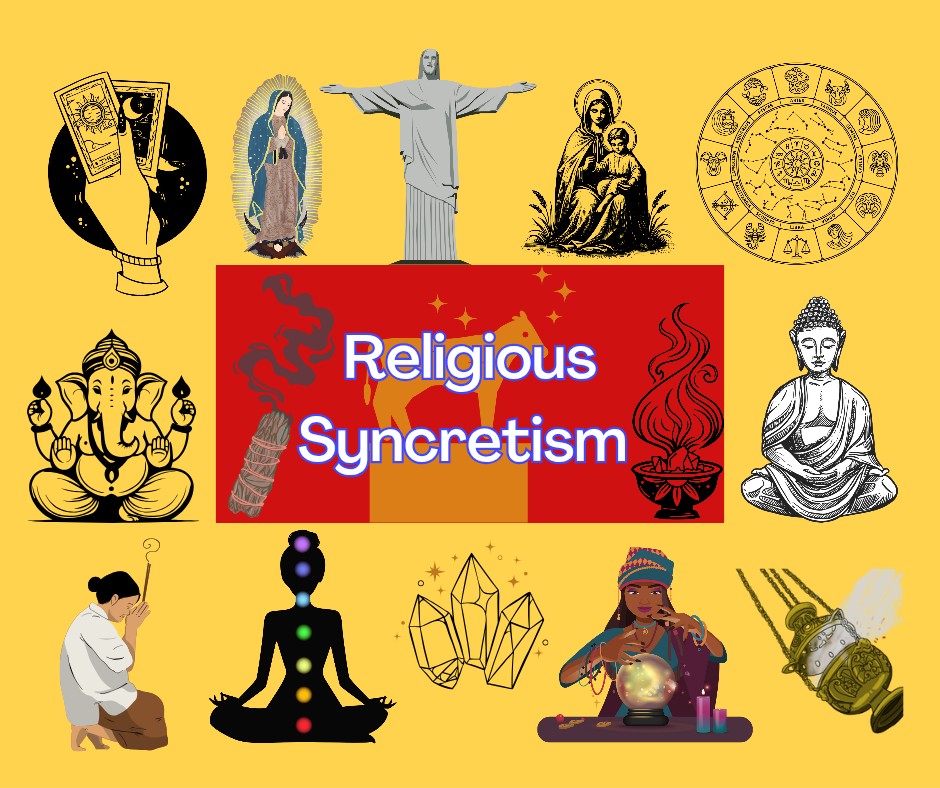
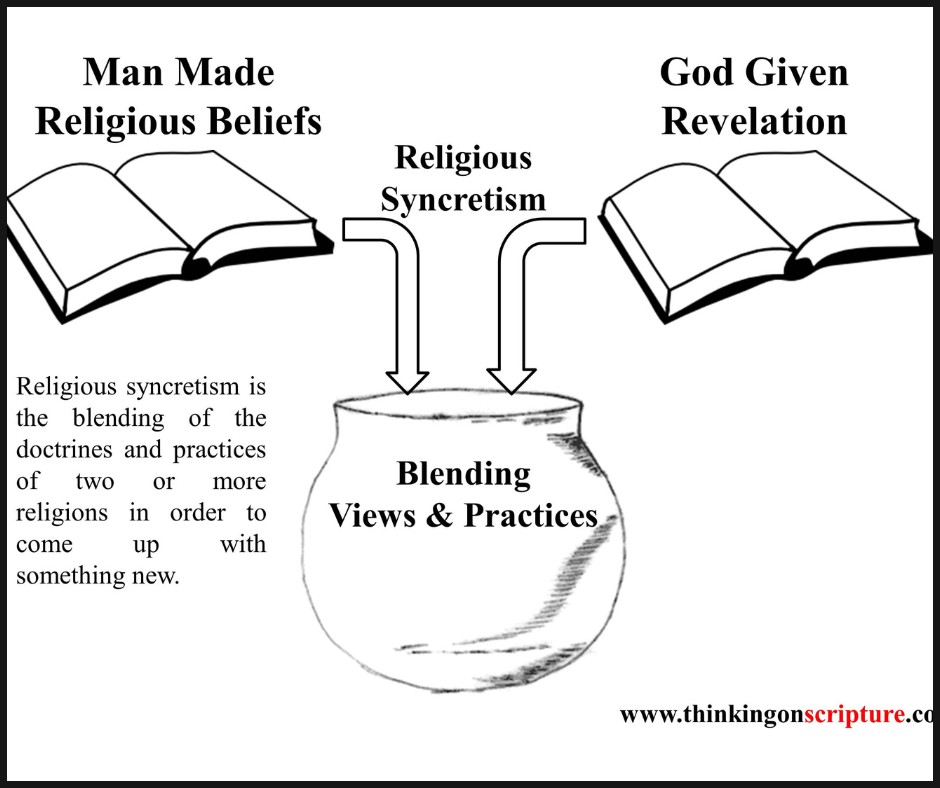
As believers, we need to be watchful that we do not fall prey to religious syncretism. Syncretism is the combination of different forms of belief or practice. Religious syncretism is defined as the blending of the doctrines and practices of two or more religions in order to come up with something new. This can show up in leaders, churches, denominations, and even in our own lives.
As we grow in our relationship with God and in knowledge of the Word, we have a greater ability to recognize how syncretism shows up in these areas. When we spend time studying, we can more easily pinpoint what is and is not from God. Our spirit is strengthened, and our discernment is sharpened to better discern good and evil. This is why it is imperative to read and study the Word for yourself. We can not solely leave our spiritual development in the hands of another person.While seeking to mature in our faith, we must allow the Holy Spirit, the Spirit of Truth, to be our teacher. He will lead us into all truth. With His guidance, He will reveal areas of idolatry and syncretism in our lives. With the Holy Spirit’s revelation, it is important that we remove it, no longer allowing it to be attached to our lives.
Listed below are some practical ways to remove idolatry and syncretism from our lives. This is not an exhaustive list. There may be other ways the Holy Spirit leads you on your journey to freedom from idolatry.
Put It into Practice: How to Remove Idolatry from Our Lives
- Access: Allow the Holy Spirit to reveal areas where there is idolatry in your life.
- Confession: Confess your sin to the Father (1 John 1:9)
- Repentance: Turn from your sin and turn back to the Father
- Commitment: Commit your ways to Yah and live a Spirit-led life. When you walk in the Spirit, you will not fulfill the lusts of the flesh.
- **Prayer and Fasting: Consecrate yourself to a time of prayer and fasting. When you set apart time to do so, it gives you the ability to be freed from the chains of idolatry.
Apply It to Our Lives: How to Stay Free of Idolatry and Syncretism
- Do not participate in the abominable practices the Most High has forbidden.(Deuteronomy 18:9-13)
- Remove all forms of idolatry that we have learned and/or accepted from our former way of living and thinking prior to salvation.
- NO mixture or compromise. Serve Yah wholly.
- Remove physical idols (graven images, statues, gods) from our household.
- Remove any form of idol and ancestral worship from our lives.
- As children of the Most High, we are created to serve and worship Him alone. We do not create altars to bow down and worship graven images and our ancestors. We do not worship or seek to communicate with the dead.
- After removing the idols and altars from our home, pray over and anoint our house with oil.
- Separate ourselves from family, friends, or others who practice divination or witchcraft. Draw a line and take a stand for righteousness.
- Do not consult psychics through tarot card readings, tea leaf readings, palm readings, etc.
- Stop using astrology (signs and horoscopes) to guide your life and give you an understanding of yourself and others.
- As believers, we do not identify ourselves through a zodiac sign. Our identity is in Christ alone.
- Do not consult mediums or spiritists.
- We should not seek to communicate with spirits . The only spirit we should communicate with is the Holy Spirit.
- To stay free, we must have a greater sensitivity to the Spirit of God to hear Him lead us from any idols and idolatrous practices.
- When our spirit is strengthened, we have a greater ability to discern the voice of God and follow His guidance.
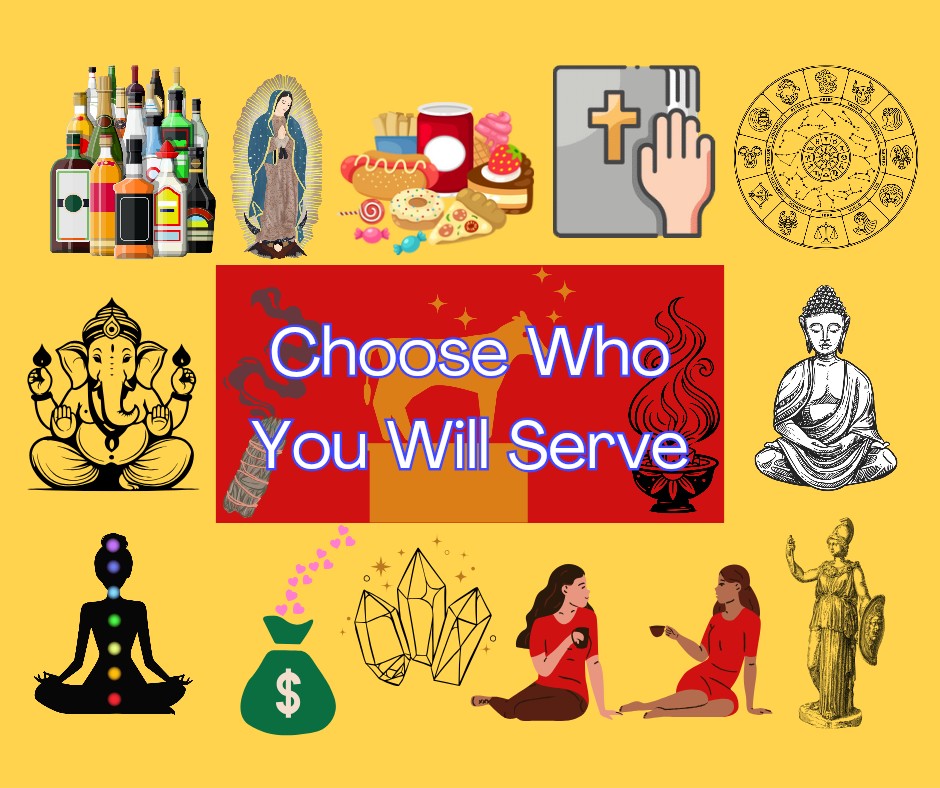
- Overall, it comes down to each of us making a decision of who we will serve. Will we serve Yah alone with all our heart, soul, and strength? Or, will we serve the idols we have grown accustomed to? The choice is a personal decision that no one can make for you.








You must be logged in to post a comment.