
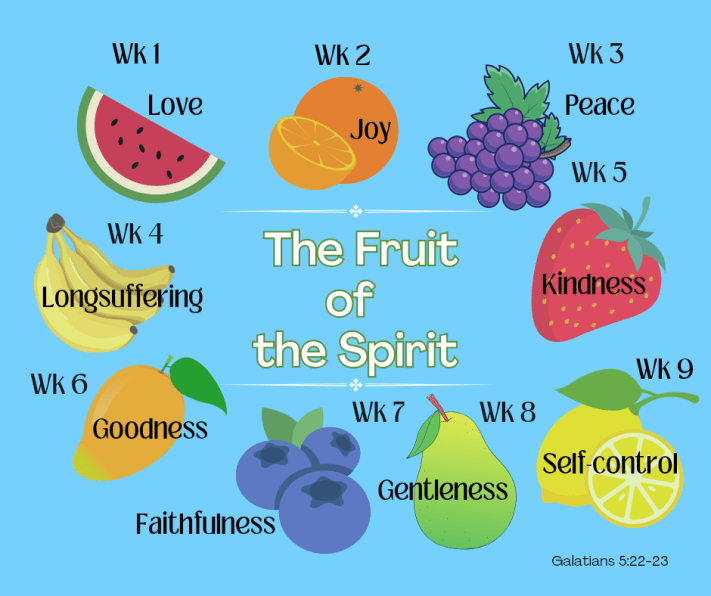
- Week 1: Walking in Love
- Week 2: Walking in Joy
- Week 3: Living a Peaceful Life
- Week 4: Patiently Enduring as Believers
- Week 5: Extending Kindness to Others
- Week 6: Seeking to do Good Toward Others
- Week 7: Remaining Faithful as Believers
- Week 8: Walking in Gentleness
- Week 9: Exercising Self-Control
Tag: Fruit of the Spirit

Week 9 Fruit of the Spirit: Self-Control (Temperance)


We’ve made it to the final week of our discussion on the Fruit of the Spirit!! 🎉🎊🎈I hope you have enjoyed this time of exploring each fruit. If these posts have been helpful to you, please share them with others. This topic is beneficial for all believers whether you are newly converted or have been saved for many years. In our journey as followers of Christ, it’s important that we walk in the Spirit. When we do so, we will not fulfill the flesh’s lustful desires. We must have the awareness that what our flesh desires is contrary to what the Spirit desires. The two war against one another. As believers who walk in the Spirit and are led by the Spirit of God, we are able to produce spiritual fruit. In John 15, Christ lets us know He is the True Vine and his followers are the branches. When we, the branches, remain in fellowship with Him, we are able to bear fruit. But if we are separated from Him, we are unfruitful. In everything that has been discussed, I pray that you will be reminded of that fact and stay connected to the One who enables us to bear fruit.
In today’s blog, we will go over what self-control means and examine how we can exercise it our lives when overcoming temptation and in difficult situations.
Understanding Self-Control
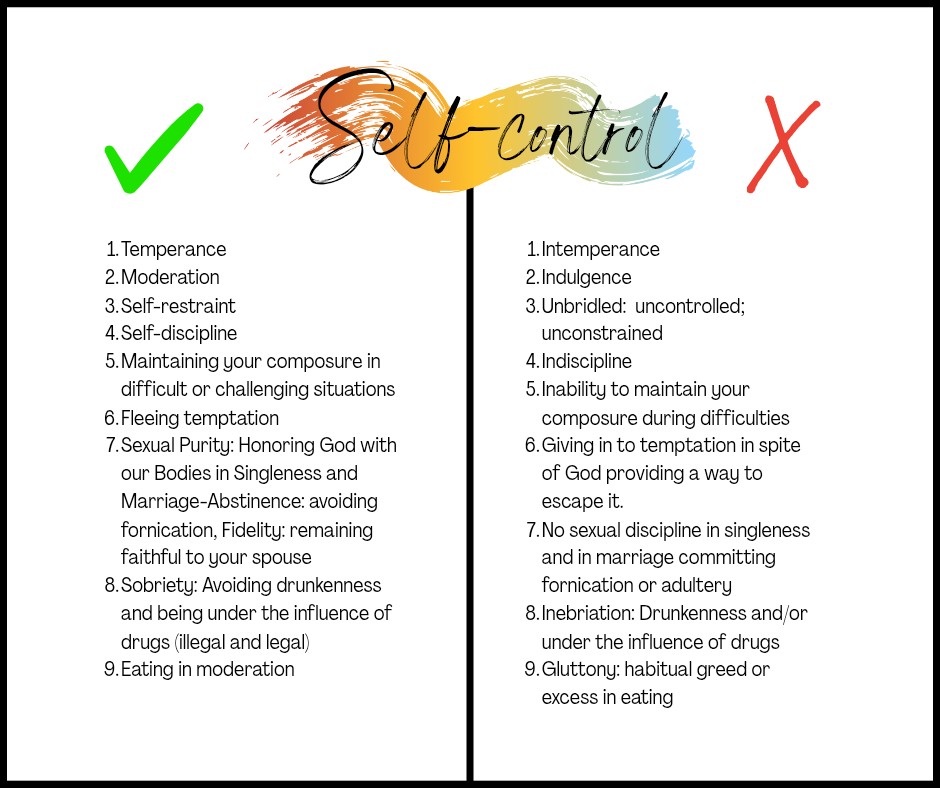
Self-Control is…


Self-Control is not…

Examples of Self-Control
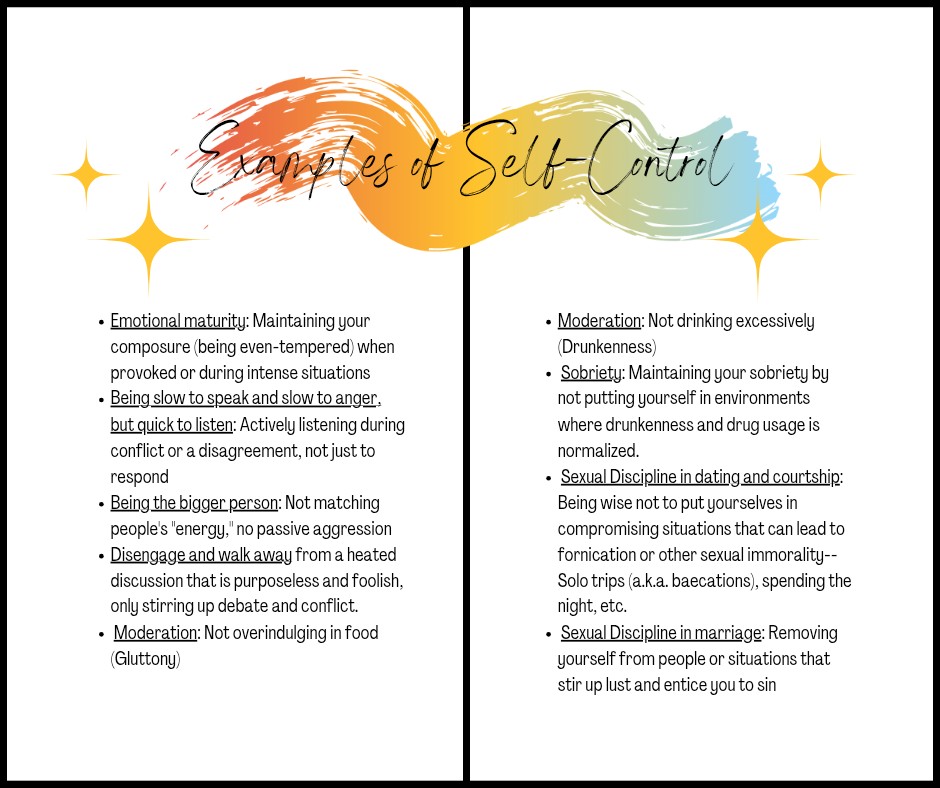
Overcoming Temptation and Exercising Self-Control


When we are mindful of the situations and places we put ourselves in, it will help deter us from falling into temptation. If we are maintaining a lifestyle of sobriety, it wouldn’t be wise to hang around people who live an ungodly lifestyle ruled by alcohol and drug usage. That would be counterproductive in having a set-apart lifestyle. That’s why it is important to CHANGE YOUR ENVIRONMENT. When what had you bound is readily accessible, it makes it easier to return to your bondage. But when you are in a new environment, free from your former vices, it helps to prevent you from going back to alcohol and drug usage.
Another area to overcome is sexual temptation. This area is for both single and married believers. It doesn’t discriminate based on marital status. Whether you are married or single, the enemy will bring temptation to lead you to sin. As believers, we must address anything that threatens our sexual purity. For those who are single, we must be more aware of what we receive in our lives that stirs up lust and can lead us to engaging in fornication or other types of sexual immorality. It’s important to examine the people in our lives: who we associate with, who we call friends, and who we are dating/courting. We should ask ourselves: Are we equally yoked in these relationships? Or, do they cause us to be tempted to sin? Do they indulge in the activity that we are intentional about abstaining from? Are they a stumbling block in our journey of walking in purity?
These are just some questions to consider when examining the associates, friends, and romantic partners in our lives. Also, it’s necessary to examine ourselves so we do not serve as a stumbling block for others, tempting them to engage in sin. Our focus should not be one-sided, only fixated on others’ behavior. We need to be mindful of our conduct to ensure we are not leading anyone astray. Next, we should analyze what we receive through entertainment (TV shows, movies, music, etc.) and social media. Anything we consume on a regular basis can shape our perspective on a matter. So, we should be aware of the messages we are surrounding ourselves with.
For married believers, they can also face sexual temptation. This type of temptation is not just exclusive for the unmarried. The enemy will send his minions (as I like to call them) to sow seeds or bring about the destruction of a marriage through adultery. Some come in the form of friends and associates who sow seeds that make adultery look harmless. They justify behavior that can lead to adultery or is flat-out adulterous. These individuals do not value the sanctity of marriage and diminish the consequences that come with this sin. Also, there are Satan’s minions who serve as the temptation. They’re not the seed sower; instead, their purpose is to get you to commit adultery with them. That is why it’s crucial to be self aware of what can arouse lust in you and who around you can feed into it. Outside of your marital union, it is vital to recognize if your relationships with associates and friends are equally yoked. Otherwise, they could be harmful to your marriage and sexual purity.
Additionally, for both single and married believers, we must hold ourselves accountable for overcoming temptation. We can not solely put the blame on others. We must do our part when temptation arises in our lives. When it comes, we must recognize and flee from it. No matter how great or small, the temptation should be addressed, and we should actively look to remove ourselves from it. Temptation is not something to play with. We shouldn’t allow it to stir up lust enticing us to sin. That is why we need to recognize it and remove it from our lives. Depending on the situation, we may not be able to completely remove ourselves from it, but we should be intentional in providing a substantial amount of distance between ourselves and the said temptation. This includes matters in which we still have to work or have some basic interaction with the tempter. It would be beneficial to use Godly wisdom in these situations.
We also have the reassurance based on 1 Corinthians 10:13, that when we are tempted, our Father gives us the willpower to overcome and provide a way of escape. We can rest in the fact that when temptation arises, we are strengthened by God to overcome it. And, not only that, He will give us the opportunity to be freed from it. That is a win-win. But in order to be successful, we have to exercise self-control, not giving in to the temptation. We should be deliberate in looking for the way out that our Father will provide for us.
The third area to exercise self-control is overcoming the temptation to overeat. We can not say we have self-control if gluttony is running, or rather, ruining our lives. We can not allow food to consume our lives. We should eat to live, not live to eat. I can admit this area hit home for me. I can say there were times when I used food for comfort more than anything else. I was living to eat instead of eating to live. I was using it for emotional support, covering up the real issues I was facing. Over time, things have improved, and I am taking it one step at a time. I don’t want food to rule over me. Instead, I decided to make better food choices with healthier alternatives.
To make it applicable to each of our lives requires a change in mindset. We are not just changing how much we eat but also what we eat. Moderation is important as well as healthier alternatives. One change I’ve made is no longer deep frying my food. For certain foods, I still pan fry them; but, for the most part, I use my air fryer. If I do have something deep fried, it’s occasionally when I purchase it from the grocery store or a fast food restaurant.
Another way to exercise self-control and prevent overeating is portion control when going out to eat. This is especially helpful at buffets. Instead of piling our plates with food that we may not eat or can cause us to overindulge, we can choose smaller portions. We put enough food on our plate that we know we will finish. And if we are not full, going back for seconds only if needed. There are other ways we go about eating in moderation. But what’s important is understanding why we overeat and allowing the Holy Spirit to lead us in making better decisions that will lead to healthier outcomes. We must remember that our bodies are the temple of the Holy Spirit, and we should be responsible for taking care of them. With the Holy Spirit’s help, we can eat to live, not live, to eat.
Exercising Self-Control in Difficult Situations
In the previous section, we discussed physical actions to practice self-control. Now, we will focus on our emotional responses during difficult situations. In life, certain circumstances are unavoidable; we will face difficult situations and people. Regardless of what or who we encounter, it’s important to handle the matter the right way. As believers, we can not resort to old habits and behaviors when dealing with difficulty. We are new creations in Christ, the old has passed away and all things are made new. (2 Corinthians 5:17) Being a new creation calls for a new response to the trials and challenges of life. We are a new creation that has a new nature led by the Spirit of God, no longer ruled by our sinful flesh.
When we are spiritually renewed, our emotional reactions should reflect who we belong to. With the help of the Holy Spirit, we can learn to manage our emotions during difficulties. I’m not saying we will never have intense moments that cause us to react with emotions such as anger, sadness, or fear. Instead, when that happens, it should not overtake us. We can’t stay in the state of being ruled by our emotions. As children of God, we can bring it to our Father who will help us. He will not leave us in the condition we are in. His Spirit comforts us, and He strengthens us, giving us the willpower to endure through it. He may not always change the situation we are in; but the Word guarantees us that He will give us the ability to persevere through it. It is YAH’s wisdom that helps us navigate through the challenges and trials in our lives.
As we mature in our faith and allow the Spirit of God to lead us, our responses change and reveal a greater level of emotional maturity. When we’re able to control our emotions rather than allowing them to rule us, it shows growth. As difficult situations arise in life, we are able to express certain emotions without it taking us out of our Godly character. On our jobs when dealing with instigating coworkers who are constantly meddlesome looking to stir up drama and discord, we have to remain even-tempered and allow God to fight on our behalf. We are God’s children; we don’t match people’s “energy.” We don’t repay evil with evil. Our response to difficulties should not mirror the world’s response. When the unbeliever is eliciting a reaction from us, we should not give them that satisfaction. If dealing with a person or group of people who are disrespectful and insulting you, we don’t respond in the same manner.
We must recognize that in these situations and similar cases, it’s not wise to behave in the same manner as the world. No matter how great or small the situation may be, we are still Christ’s representatives. We can not effectively represent Him if our emotional responses are irrational, impulsive, and reckless like the world. We have to be willing to put our flesh in check. We can not afford to say what’s on our mind with no thought of the damage it does to the recipient. We are not called to “check” someone and put another person in their place. There is a difference in speaking up and addressing a matter at the right time and place. But when we do, it should be done in the right spirit, not lashing out at the individual or group driven by unchecked emotions.
As believers, when engaging with others, whether positive or negative, we should remember who we represent. We are set apart and the light of the world. How we handle conflict and difficulties should be a noticeable distinction from the world. From our emotional responses in challenging times to everyday reactions, we should reflect who we are (children of the Most High God) and who we belong to (YAH).
RECAP

**Scriptures used from the New King James Bible and the authorized King James Bible
**Definitions used from the following dictionaries: Cambridge, Merriam-Webster, Oxford, and Webster’s Dictionary 1828
Recap of the Nine Fruit of the Spirit
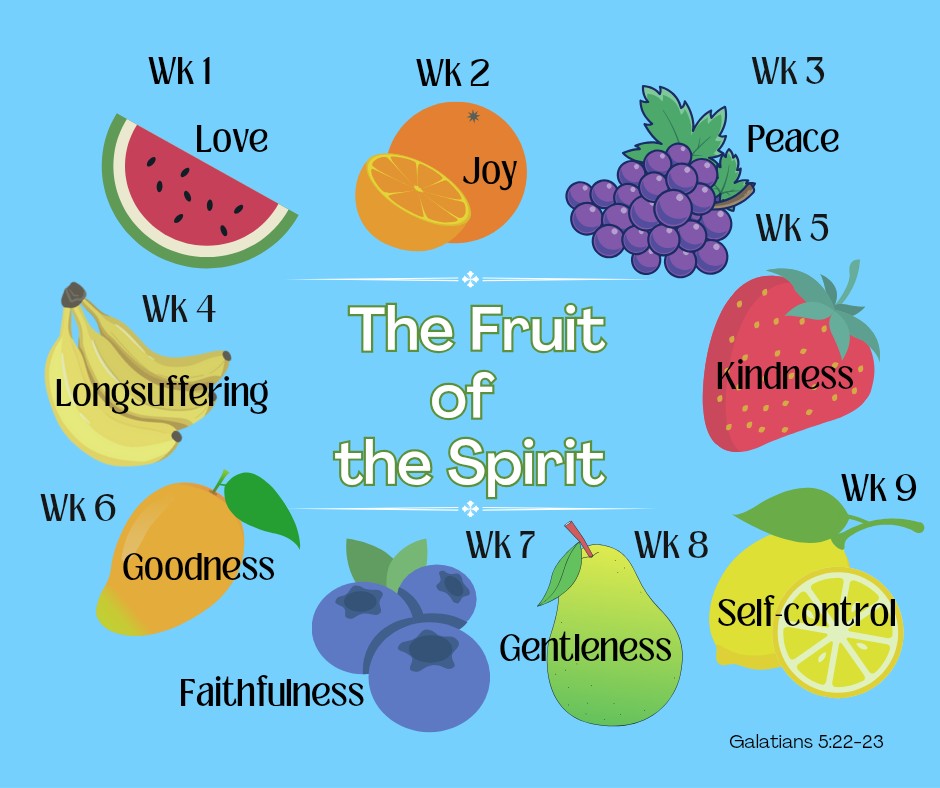
- Love: Walking in Love
- Joy: Walking in Joy
- Peace: Living a Peaceful Life
- Longsuffering (Patience): Patiently Enduring as Believers
- Kindness: Extending Kindness to Others
- Goodness: Seeking to do Good toward Others
- Faithfulness: Remaining Faithful as Believers
- Gentleness: Walking in Gentleness
- Self-Control (Temperance): Exercising Self-Control
- Current post

Week 8 Fruit of the Spirit: Gentleness


Hello everyone!! We’ve made it to the 8th week of our Fruit of the Spirit discussion. This has been a great learning experience that has shown me how important each fruit is in the lives of believers. We can not produce them in our own strength but only by the Spirit of God. As I previously mentioned, these spiritual fruit are cultivated in our lives as we abide in Christ. To bear fruit, we must remain in Him. And remaining in Christ allows the Father to prune us, removing anything that hinders our ability to produce spiritual fruit. I hope that we will use these discussions as a means to reflect on our daily lives and interactions with others to examine the fruit we are producing. And, if there are any areas where we’re lacking, we would allow the Father to prune us in order to be more fruitful.
In today’s blog, we are exploring the fruit of gentleness. We will discover how we can use Godly wisdom to maintain gentleness in our conduct and conversations with others.
Understanding Gentleness
In order to walk in gentleness, we must have an understanding of what it is and what it is not.
Gentleness is…
Gentleness is not…

With the definitions, synonyms, and antonyms listed above, we should now have a clear understanding of what gentleness means. Based on this information, we can look at our lives and examine if we are walking in gentleness or if we need to improve in this area. For some, this comes easily, while others of us need more work. No matter which end of the spectrum you find yourself on, we can ask God to help us to be consistent and authentic in our walk. It’s a privilege that believers have, not having to depend on our own strength. Instead, we have our Father who empowers us in doing so. He does not force us, but when we decide to walk in gentleness, He gives us the ability to do so.
So I pose the question: Within the various areas of your life, is the fruit of gentleness evident? On your job, would you be described as gentle or rough? In your home, would your spouse describe you as aggressive, argumentative, and rigid? Would your children consider you to be unkind, harsh, and demanding? Do those outside your home receive a more gentle version of you than those you live with? There’s a time and place for everything. We can find ourselves in situations where it’s necessary to be firm in our approach, choosing to be stern with our actions and words. But everything should be said and done from a place of love and consideration of the other person, not with the intention of mistreatment through belittling and degrading.
During times of correction and discipline, children should know–even though they may be upset–that they are still loved. The discipline they receive should not be used as a form of abuse or mistreatment but to correct bad behavior and lead them down the right path. In our relationships–not only in marriages–when we disagree or there is something the other person may have said or done that bothered us, we shouldn’t become aggressive and unkind turning the matter into an argument. These are just a few areas to take into consideration to recognize whether or not we are displaying gentleness. In the next section, we will discuss how we can learn to walk in gentleness.
Learning to Walk in Gentleness


To walk in gentleness takes intentionality. It’s a decision we have to make. It is important that our way of thinking is renewed in the Word. Oftentimes, how we operated prior to salvation or what we experienced in childhood shapes our interactions with others. But now, as we read and meditate on scripture, we learn how we should live as believers. We’re able to see the correct way to interact with others that reflects our identity as a child of God and our regenerated nature. It’s a process of unlearning old ways of thinking and doing and, in return, relearning through the Word aided by the Holy Spirit. It is the Holy Spirit who is the Spirit of Truth. And, He will lead us into all truth. To walk in gentleness, we need His assistance. We may encounter times in which we have resistance in extending gentleness, but the Spirit of God serves as a gentle reminder to respond or act with gentleness.
In James 3, it discusses the two types of wisdom: one is earthly, sensual, and devilish, and the other is from above (Godly wisdom). Godly wisdom brings us to a place of maturity, allowing us to operate in a manner that is peaceable and gentle. God’s wisdom will lead us to handle matters the correct way. We won’t be driven by our feelings, allowing our flesh to dictate our reaction. When an issue or conflict arises, we are not reactionary. We are soberminded and handle it with wisdom. Being even-tempered gives us the ability to offer a gentle response in the midst of a difficult situation. Proverbs 15:1 shows us that a soft or gentle answer turns away wrath, but harsh words will stir up anger.
To walk in gentleness, we need the ability to endure longsuffering. We have to be forbearing with one another. When difficult situations arise, it will test our patience to see if we can still display love and gentleness to the other person. It takes Godly wisdom to restrain yourself from saying or doing something that is not Christ-like when involved in a heated matter. People may intentionally instigate or agitate you to elicit a negative response. As believers, it’s imperative that we be prepared for these situations and respond in a way that is pleasing to our Father rather than satisfying the other person.
Lastly, in our daily conversations, it is necessary to put off the old man and its former conversations. The way we talk now should be edifying, not tearing down. Once we are born-again, we should no longer continue talking in a manner that is harsh, confrontational, belittling, disrespectful, or is flat out degrading. Our nature changes when our inner man is regenerated. Through the process of sanctification, the Holy Spirit works on the inside of us, making us more like Christ. Our conduct and conversations are changed, reflecting the inward change that has taken place.
RECAP
- Understanding Gentleness
- Gentleness is…
- The quality or state of being gentle
especially : mildness of manners or disposition - The quality of being calm, kind, or soft
- Similar words: tenderness, kindness, meekness, and softness
- The quality or state of being gentle
- Gentleness is not…
- Aggressive
- Argumentative
- Callous
- Demanding
- Harsh
- Rough
- Unkind
- Within the various areas of your life, is the fruit of gentleness evident?
- Gentleness is…
- Learning to Walk in Gentleness
- Being renewed in the Word
- Unlearning old habits and ways of thinking and relearning through the Word, aided by the Holy Spirit
- Having Godly wisdom
- Endure longsuffering, being able to fobear with one another
- Putting off the old man and its conversations
- Being renewed in the Word
**Scriptures used from the authorized King James Bible
**Definitions used from the Oxford, Cambridge, and Merriam-Webster Dictionaries
Next Week’s Blog: The Final Week of the Fruit of the Spirit



Week 7 Fruit of the Spirit: Faithfulness

Hello everyone!! I pray the past 6 weeks have been beneficial in helping you cultivate the fruit of the Spirit in your lives. As believers, we should examine ourselves to pinpoint areas where we may be less fruitful. With the help of the Holy Spirit, He enables us to produce more fruit. As well as when we abide in Christ and He abides in us, we are capable of bearing fruit. It is important for us to recognize our need to remain in Christ in order to produce all nine spiritual fruit.
In today’s blog, we are exploring the fruit of faithfulness. We will examine Hebrews 11, which is commonly called the Hall of Faith. Within this passage, we will highlight 5 faith figures who are listed in the Book of Genesis and discover what we can learn from each of them.
5 Faith Figures
(1) Abel (Hebrews 11:4, Genesis 4:1-10)
Our first faith figure is Abel. He is the secondborn son of Adam and Eve. In Genesis 4, he is compared to his older brother Cain. Abel was a shepherd (keeper of the sheep), and Cain was a farmer (tiller of the ground). At a certain time, the two brothers each brought offerings to YAH. Cain brought some fruit from the ground. Whereas Abel brought the firstborns of his flock and the fat from them. In the text, it shows that God had respect unto Abel and his offering. This meant both Abel and his offering were acceptable in the sight of YAH. But as for Cain and his offering, God had no respect for them. This caused Cain’s disposition to change.
Instead of seeking to present himself and a better offering to the Father, He became very angry and his countenance fell. YAH questions Cain about his response. In doing so, we see how important it is to do well. I can imagine the heart posture behind each brothers’ offering was different. For Abel to give the firstborns of the flock and the fat from them is a sign of giving God the best portion. With Cain, there was no mention of the fruits of the ground being the firstfruits. He may have randomly chosen some fruit with no real thought of giving the best to God.
◇Lessons Learned from Abel◇
What we can learn from Abel is to give God our best. No matter what capacity it may be, we should seek to do what is right and acceptable in the sight of YAH. Though we are no longer offering burnt sacrifices, instead, we should be a living sacrifice seeking to do the will of the Father. When we have the opportunity to do good, we should do so. We should remain faithful to our God and continue to give Him our best.
(2) Enoch (Hebrews 11:5, Genesis 5:18-24)
Our second faith figure is Enoch. We are introduced to him in Genesis 5. He’s the son of Jared, the father of Methuselah, the grandfather of Lamech, and the great-grandfather of Noah. He was a righteous man who lived 365 years before being taken by God to heaven, never experiencing death. His testimony was that he pleased God. [Hebrews 11:5] It is mentioned in verses 22 and 24 of Genesis 5 that Enoch walked with God, signifying a close relationship with the Father. It’s an amazing testimony to not only be in close fellowship with YAH but to be spared from facing death.
◇Lessons Learned from Enoch◇
From Enoch, we see the fruitfulness of walking with God. By his commitment to serving YAH, not only was he blessed, but so were his descendants. He left a legacy of righteousness that was passed down throughout the generations. His example would no doubt be a great impact on his son, Methuselah, who would become Noah’s grandfather. While we may not have the same end result as Enoch, we should have the testimony that we pleased God. By the end of our life, our desire should be to hear God say, “Well done, my good and faithful servant.”
(3) Noah (Hebrews 11:7; Genesis 5:28-32; Genesis 6-9)
After discussing his great-grandfather, it’s only befitting to now explore the faith of Noah. Noah’s genealogy can be found in Genesis 5 and 1 Chronicles 1. In these accounts, I want to focus on the fact that Noah is the grandson of Methuselah– the longest living person in the Bible, having lived 969 years. And, we can not forget that Methuselah’s father was Enoch. Noah came from a lineage of righteous men. But in spite of Noah’s upbringing, he was surrounded by a society filled with wickedness. In the midst of corruption and violence, Noah was found to be just and perfect in his generations. During this time, the sons of God (angels) had taken wives among the daughters of men (women). As a result, they produced hybrid offspring, which were giants (or Nephilim). Due to the magnitude of man’s wickedness and the thoughts of their hearts being continually evil, YAH repented that He had made man and He was grieved in His heart.
The creation that He had made was corrupted and replaced with these hybrid creatures. He sought to destroy man and all living creatures from the face of the earth. But Noah found grace in sight of God. He was given the exact instructions on how to construct an ark. Additionally, God established a covenant with Noah, that he, his wife, his sons, and his sons’ wives would come into the ark to be saved from the impending flood set to destroy all flesh. God instructed Noah which types of animals to bring into the ark and how many of each kind and to gather food for his family and the animals. Noah obeyed YAH’s command, and his family was kept by God during the flood. It rained on the earth 40 days and 40 nights. After the waters receded, the ark landed on Mount Ararat.
Once the ground was dry, Noah, along with his family and the animals, went out of the ark. He built an altar unto YAH and offered burnt offerings from every clean beast and bird. God was pleased. He blessed Noah and his sons, instructing them to be fruitful, multiply, and replenish the earth. YAH established a covenant with Noah that He would never again destroy all flesh with a flood, neither would there be a flood to destroy all the earth. The sign of YAH’s covenant was a rainbow in the clouds. As a result of Noah’s obedience and faith in God, he was spared from the destruction of the flood. He and his sons were blessed by the Most High for heeding to His commands. Going forward from Shem, Ham, and Japheth, their descendants would replenish the earth.
◇Lessons Learned from Noah◇
With Noah’s life story, we can learn how great of an impact it is to heed God’s command. While society was corrupt and full of wickedness, Noah remained faithful to God. In doing so, he and his family were spared. They did not suffer the same fate as the wicked. Likewise, we should do the same. As we live in a time where wickedness is being accepted and celebrated, we must take a stand for righteousness. Even though we are not building an ark preparing for an impending flood, instead, we are building up our faith to be able to withstand these evil and dark days. It is up to each and every one of us to have faith to endure. In times of weakness, we can call on our Father, who will strengthen us. We must be like Noah and remain in fellowship with YAH. By trusting in Him, we will find safety and reassurance. We will face being ostracized by those around us who continue to promote and/or indulge in sin and wickeness. But that is expected to happen in the lives of believers. No matter the opposition, it is vital that we stay committed to obeying God and completing the work He has called us to do. Don’t allow the allure of sin to draw you away from God; instead, remain faithful to Him.
(4) and (5) Abraham and Sarah (Hebrews 11:8-11, 17-19; Genesis 11:26-32; Genesis 12-25:11)
Our next faith figures are Abraham and Sarah. We first encounter them in Genesis 11. At this time, their names are Abram and Sarai. Abram is from the lineage of Shem and the son of Terah. Sarai is his wife. They are from Ur of the Chaldees. In the next chapter, YAH instructs Abram to leave his country, his family, and his father’s house to journey to a place where God will lead him. God prophesies that He will make Abram a great nation, He will bless him and make Abram’s name great. Those who bless Abram, YAH will bless. And, those who curse Abram YAH will curse. Through this one man, all the families of the world will be blessed. He heeds God’s command, and at the age of 75 he leaves his father’s house in Haran along with Sarai and his nephew Lot. While on his journey, Abram is prosperous. In Chapter 12, the text tells us Abram was very rich in cattle, silver, and gold. It is evident that YAH’s hand was on his life. Regardless of the highs and lows of his travels, he was kept by God.
(Genesis 15) By this point in Abram’s life, he and his wife are childless. But YAH appears to him in a vision. It is foretold that Abram will have a child of his own as well as descendants too numerous to count. Abram believes, and it is counted to him for righteousness. YAH instructs him to make an offering, and Abram obeys. While in a deep sleep, Abram learns the fate of his descendants. They would be afflicted, held captive for 400 years, serving another nation in a strange land. God would judge the nation, and the people would come out with great sustenance. (Prophecy of the Israelites’ captivity in Egypt and their Exodus from the land of Egypt journeying to the Promised Land) YAH made a covenant with Abram that his descendants would be given the Promised Land from the river of Egypt unto the Euphrates River.
After Abram’s encounter with God, he and his wife still have not conceived a child. Sarai, being well past childbearing age, believed she would not bear children for Abram. She suggests that Abram have a child with her Egyptian handmaid, Hagar. He complies with his wife’s suggestion. They have taken matters into their own hands. As a result, Hagar conceives, and this causes conflict within the household between the two women. Hagar gives birth to Ishmael. But he is not the promised child, which YAH prophesied would come from Abram.
By Chapter 17, YAH appears to Abram, who is now 99 years old. He establishes His covenant with Abram that he will be a father of many nations. Additionally, his name is changed to Abraham. This covenant will be unto Abraham and his seed in their generations. The land of Canaan is the promised land for them to receive as an everlasting possession; and, YAH will be their God. The sign of this covenant was male circumcision. All who keep this covenant were required to be circumcised from 8-day-old babies to those who were born in the house or had been purchased with the money of foreigners. In the same way that Abram received a name change, so did Sarai. The name given to her was Sarah. God tells Abraham that He would bless Sarah and foretold of the promised son whom she would birth. She would be a mother of nations, and kings would come from her.
Abraham laughed at the thought of conceiving a child at his and his wife’s old age (99 y.o. and 90 y.o). God reiterated that she indeed will give birth to a son, and his name will be Isaac. Through this promised child, YAH’s covenant would be established to him and his seed thereafter. Even though Isaac was the promised son, Ishmael will still be blessed and fruitful. From him will come 12 princes, and he’ll be a great nation. The promised son, Isaac, was prophesied to be born at the set time next year. Abraham’s response was obedience to YAH’s command. He took all the males in his household and circumcised them. When Sarah learned of the prophetic word concerning conceiving a son, she laughed to herself. Once she recognized the seriousness of the matter and that nothing is impossible for God, she denied laughing about the situation. Just as God said, Sarah conceived and gave birth to Isaac at the appointed time. Through Sarah’s faith, she received strength to conceive and birth Isaac, though she was past childbearing age. She knew God was faithful to do what He said.
Lastly, Abraham’s faith is evident when he was instructed by God to offer his son Isaac as a burnt offering. This was the promised son that YAH had prophesied about, the heir to the promises of God. But now Abraham was being tested to see if he would give his son to YAH as a sacrifice. Abraham was in the process of preparing Isaac to be sacrificed when God intervened. YAH saw Abraham’s obedience, choosing not to withhold his only begotten son. And, in place of Isaac, God provided a ram that was caught in a thicket. So Abraham offered the ram as burnt offering. With Abraham’s willingness, he passed the test.
◇Lessons Learned from Abraham and Sarah◇
With Abraham and Sarah, there’s much that we can learn from them. In the beginning of their story, we see their willingness to follow God when YAH tells Abraham to leave his country, his family, and his father’s house. Abraham departs with his wife and his nephew Lot. While Abraham is faithfully following YAH, he is very prosperous. At one point, he and his nephew have amassed numerous possessions, so much that there’s not enough land for both of them. Abraham and Lot amicably separate from one another. After Lot leaves, YAH makes it known the future plans He has for Abraham and his descendants. We can learn from Abraham that there is a time when separation is necessary. What God was doing in his life, he had to be removed from among his family. There are times in which our environments and the people in them are not conducive for what God needs us to do. They can be stumbling blocks that stifle our growth in God or draw us away from Him. If God has us to separate ourselves, it is important that we follow his instruction.
Next, with both Abraham and Sarah, we see the importance of holding on to our faith until what God promises comes to pass. We saw this with the birth of their son, Isaac. At first, they took matters into their own hands when Sarah gave Hagar to Abraham to conceive a child. The child was blessed by the Most High, but he was not the promised son who was foretold. That seed would come through Abraham and Sarah, not Abraham and Hagar. When God prophesied of Isaac’s birth, it took faith for the couple who were past childbearing years to believe for the word to come into fruition. They had to trust God to see the promise fulfilled rather than leaning on their own understanding. To apply this level of faith in our lives, we need to believe that what God said it will come to pass. What may seem impossible is possible with God.
Lastly, we see how great Abraham’s faith was to willingly offer his son as a sacrifice to God. That requires strong faith that is built by trust in God. For the average person, it would be difficult to wrap our minds around the fact of offering our child as a sacrifice. Even though we are not tested in the same manner, there are other areas that may require sacrifice. It can be our time. There are times that we set apart to commune with God. We are still in which we remove any distractions to be able to hear His voice more clearly. Instead of binge watching our favorite tv show for several hours, we can dedicate time for prayer and studying the Word. In the time we use enjoying entertainment, we can replace it with service. We can look for ways to extend kindness and goodness to others (serving/ volunteering) rather than being wrapped up in indulging ourselves. I’m not saying, never take the opportunity to relax and enjoy certain activities. It can be done in moderation while still utilizing time to serve others.
Also, sacrifice can come in the form of giving our possessions to those in need. We may have clothing, household items, or other possessions that we can donate rather than hoarding them for ourselves. If it can be used by someone else, it is better to freely give it away instead of keeping it.
Brief Summary of Faith Lessons
(1) Abel
- Give with the right heart posture
- Give God our best
- Present our bodies as living sacrifices that are acceptable to God and seek to do His will
(2) Enoch
- Walking in close fellowship with the Father leads to fruitfulness
- Leaving a legacy of righteousness
- Our life’s testimony should be that we pleased God.
(3) Noah
- Remain faithful to God, choosing to walk upright, regardless of wickedness being accepted and celebrated in society.
- Take a stand for righteousness
- No matter the opposition, stay committed to obeying God and completing the work He has called us to do.
(4) and (5) Abraham and Sarah
- Trust in YAH to lead you when He separates you from what is familiar
- Trusting God with the unknowns and uncertainty–Find peace and reassurance in YAH
- Remain faithful to see the promise come to pass
- The conception and birth of Isaac at the set time as mentioned by God
Put it into Practice
- Are there areas in your life that are causing you to struggle with remaining faithful?
- Challenge: Read the story of Joseph analyzing how he remained faithful to YAH and displayed the fruit of the Spirit throughout family conflict, imprisonment, serving in Egypt, and the reunification with his father and brothers. (Genesis 37, 39-50)
Next Week’s Blog



Week 6 Fruit of the Spirit: Goodness


Hello everyone!! We’ve made it to week 6 of our discussion. There are only 3 more fruit to explore. Throughout my time of preparation for each week’s blog, it has been fascinating to be able to learn and grow while sharing with you all. I hope that as you journey along, you are gaining new insight on each fruit of the Spirit. I have found it interesting to see how the various fruit are intertwined with one another. But the most noticeable is love. It is love that bonds everything together. Choosing to operate in genuine love that comes from the Father is the key that enables us to produce the remaining eight. Our previous discussions should bring awareness that all nine are a packaged deal. We shouldn’t produce only a few while neglecting to have the others. All should be displayed in our lives.
In today’s blog, we will discuss goodness. By examining the scriptures, we are able to see how we can seek to do good toward others. This discussion will challenge us to have a greater level of selflessness. We can not seek to do good to others while we are full of ourselves, wrapped up in selfish ambitions and our own needs. In the next few sections, we will go over the call to do good toward others, how to persevere in goodness, and how we can show goodness to others.
The Call To Do Good Toward Others

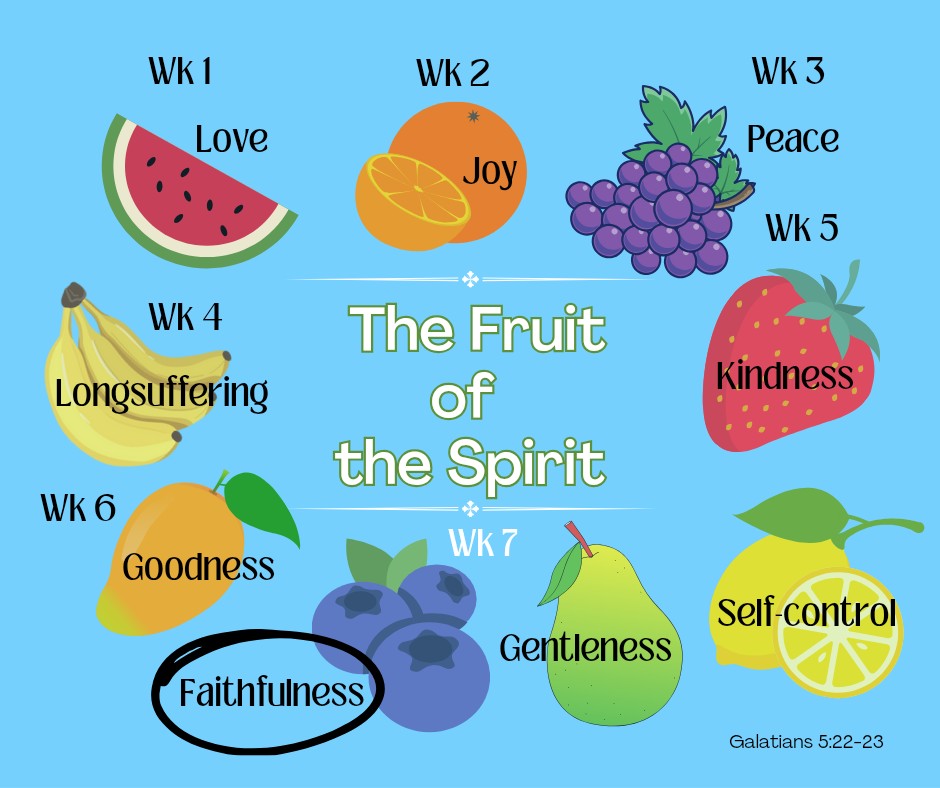
As believers, we must understand that we’re called to do good toward those within the body of Christ as well as unbelievers. Christ gives us clear instructions in Luke 6. In verse 25, He tells us to love our enemies and do good to them, which hate you. Then, in verse 35, He reiterates that same command to love your enemies and do good. That paints a crystal clear picture that love and doing good are not subject to only a select few. It’s not a suggestion. We don’t have the option to only do good to those who treat us well. If we are born-again believers, we are required to love and do good with no exceptions to the command. Additionally, Christ instructs us to bless those who curse you and to pray for those who despitefully use you. This takes maturity on the behalf of believers. There is no room for holding on to offense. But most importantly, it leaves no place for us to be vengeful seeking to retaliate for the wrong done to us. Romans 12:21 informs us that we are not to be overtaken by evil; instead, we overcome or conquer evil with good. Once we are born-again our behavior should no longer be dictated by our former sinful nature. We have to put our flesh in check and yield to the Spirit of God.
When we walk in the Spirit, it prevents us from fulfilling the lustful desires of our flesh. We put off any hatred and wrath. We are not reactionary, looking to repay evil with evil. Instead, we give room for YAH to handle the matter. We can rest in the fact that vengeance belongs to Him, and He will repay. What we believe to be a form of retaliation has no comparison to YAH’s wrath. So we need to heed Christ’s command to love and do good. In observing verse 31 in Luke 6, we see that you should do unto others as you would have them to do unto you. We’re to treat others the way we want to be treated. Furthermore, it leaves no excuse for us to mistreat anyone regardless of what they have said or done. It causes us to be responsible for our own actions and prevents us from casting blame. It guarantees that we have to do the right thing and treat people the right way.
With our call to do good toward others, there is a need for selflessness and generosity. We can not fulfill this command if we’re only concerned about ourselves and our own needs. We should look out for one another. Those who have the ability and resources should use what they have to meet the needs of others. We should not hoard all our resources when we have the capability to assist someone else. If a person has a need, those who can should be ready and willing to help the individual.
Persevering in Doing Good

As believers, it’s possible for us to become fatigued as we give and pour into others. The above scripture serves as a reminder to not grow weary as we seek to do good. While in pursuit of doing good, it’s vital that we, ourselves, are refreshed. Those who pour into the lives of others also need to be poured into. We can not pour effectively when we are depleted. That’s why times of refreshing are necessary for each and every one of us. The refreshing we need comes through presence. When we spend time in the presence of our Father, we are renewed. We are able to feel rejuvenated. Where we once felt depleted, we now have new energy. Through YAH, we receive His strength. The motivation we need to keep pressing forward is given through His Spirit. As we read and meditate on the Word of God, our minds are renewed. Our “why” becomes clear, and we don’t lose focus. Being empowered by the Holy Spirit enables us to persevere, continuing our seek to do good toward others.
How to Show Goodness to Others
- Displaying God’s goodness to others
- Rooted in love – Having a heart of compassion that is concerned about the well-being of other people (Love and concern)
- Looking out for others instead of being consumed with ourselves (Selflessness)
- Requires stripping ourselves of selfishness and putting on selflessness
- Making the necessary sacrifices for the betterment of someone else
- Being intentional in meeting the needs of others (Intentionality)
- It takes humility to consider others before ourselves. (Humility)
- Servanthood – Service to others – Volunteering
- Displaying the love of God while serving others in their time of need
- Treat people with dignity and compassion
- Serving, not out of obligation, but from a genuine desire to be a blessing to others.
- Our motives matter, our heart posture matters, and we need to examine our why.
- We need to ask ourselves, why am I serving or volunteering?
- Is it solely out of responsibility? Is it for recognition? Would I still serve if I never received any acknowledgment or praise from others? Is it a mixture of both responsibility and the expectation of recognition? Or, is it because I have the desire to help/serve in whatever capacity I can?
- We need to ask ourselves, why am I serving or volunteering?
- Examples of Service and Volunteering
- Meeting the spiritual needs of others by sharing the Gospel of Jesus Christ (Sharing the Good News with others – Evangelism)
- Serving within your church’s outreach ministry (Ministry outside of the church, reaching the surrounding communities)
- Participating in community outreach organizations
- Feeding the homeless at a local shelter
- Donating new or gently used items to local shelters
- Volunteering at a local food bank
- Hosting a (food, clothing, or toy) drive to benefit men, women, and children who are housed in a local shelter
- Giving our personal resources to meet the needs of others
- Giving clothing and household items that are still in good condition to individuals (as led by the Holy Spirit)
- Giving monetary donations (as led by the Holy Spirit)
Put It into Practice: Personal Reflection
- Are there any areas hindering you from displaying goodness to others?
- Challenge: Find an opportunity to do good toward others.
Closing Thoughts

With our discussion today, I hope it encourages you to continue to do good to others. And for those of us who need to start the process, I pray this helps to show you the importance of how we treat others regardless of their treatment of us. We’re to treat others the way we want to be treated. We are required to love our enemies and do good. As I often reiterate, there is a choice that we all have to make. We can choose to do it our way and face the consequences or YAH’s way and reap the benefits. The decision is yours.
**Scriptures used from the authorized King James Bible
Next Week’s Blog



Week 5 Fruit of the Spirit: Kindness


Hello everyone!! We are halfway through our 9-week discussion. We’ve already gone over love, joy, peace, and longsuffering. Today, we will examine the fruit: kindness. Each week, as we explore a new fruit, we see how it is connected to the previous weeks. There is no coincidence that the first listed fruit is love. Throughout the last 4 weeks, we can recognize how operating in agape love enables us to be spiritually fruitful. To produce this fruit, it’s vital to start with love, and then the others build upon it. This week’s discussion is no different. In order to extend kindness to others, we need love, peace, and longsuffering. These fruit are incorporated when we: (1) walk in the Spirit, (2) put off the old man and its deeds, and in return put on the new man, (3) walk in love, (4) walk in forgiveness, and (5) maintain our inner peace and peace with others.
What is Needed to Show Kindness to Others
(1) Walk in the Spirit
**Scripture posted separately-Galatians 5:16-26**
In the passage of scripture, it shows us how walking in the Spirit allows us to produce spiritual fruit. As believers, it’s important that we understand the Spirit and the flesh have desires that are contrary to one another. What the Spirit desires, the flesh resists, and what the flesh lusts after is against the Spirit. The two natures are always in opposition. But in order to be fruitful, we need to walk in the Spirit. When we do so, we are resisting the flesh, not fulfilling its lust. Consequentially, when we decide to operate in the works of the flesh, it not only prevents us from producing fruit, it causes us to forfeit our inheritance in the kingdom of God. We must choose if we are willing to face those consequences by allowing our sinful flesh to dictate our lives. Instead, when we walk in the Spirit, we have the ability to produce the fruit of the Spirit. In verse 24, we see that as those who belong to Christ, we are to put to death the flesh along with its passions and desires. Once we are saved, we should be Spirit-led, not driven by our flesh. Even though our inner man is regenerated, our flesh will war against all things pertaining to the Spirit.
Our spiritual walk is strengthened as we build up our spirit man. There are different ways we can be intentional in accomplishing this. We can do so when we read and meditate on the Word of God. In prayer, it cultivates a time of communing with the Father. Through our praise and worship, it causes our minds to be centered on YAH. When we prioritize building up our spirit man, we are able to yield to the Spirit rather than giving in to the persuasion of our flesh. The stronger our spirit becomes, the less of a hold our flesh has on us, influencing the indulgence in sinful behavior. With our lives being led by the Spirit of God rather than the flesh, we can put off the old man and put on the new man with its regenerated nature.
(2) Put off the Old Man and its Deeds ➡️ Put on the New Man
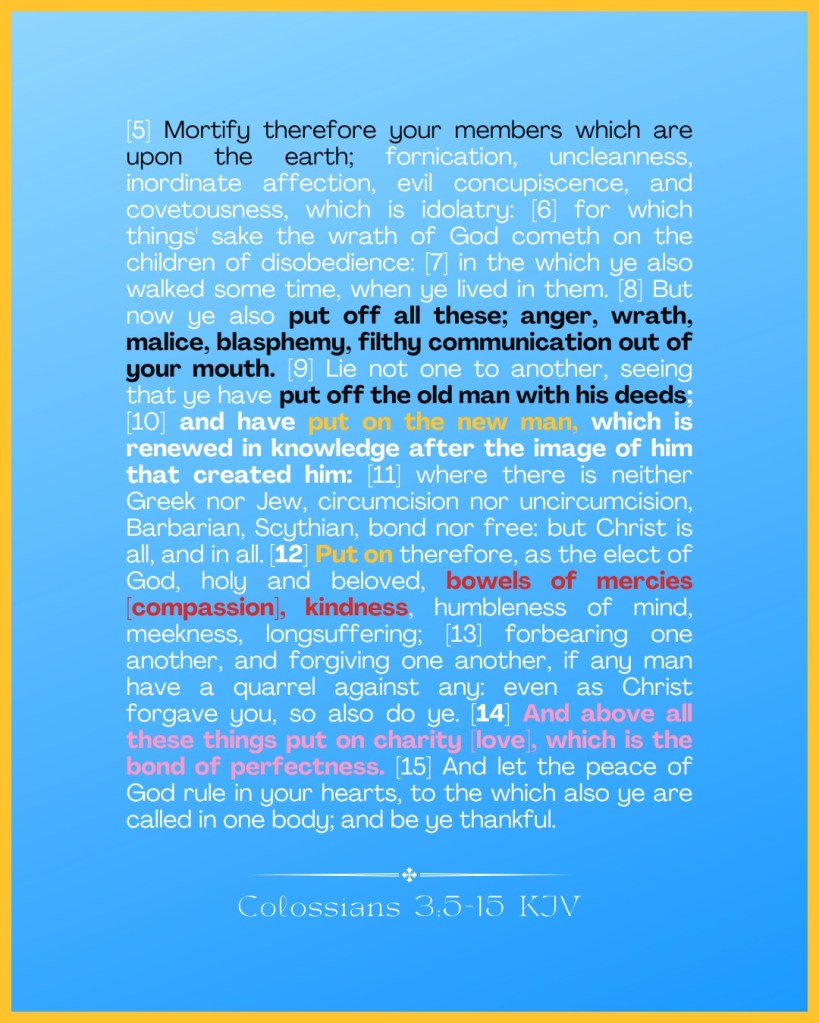
When we walk in the Spirit, it enables us to put off our old man and its sinful nature. As believers, regenerated by the Spirit of God, our nature changes. Our desires become aligned with God. As we seek after the Father and draw closer to Him, there is a noticeable distinction. When our mind is renewed in the Word, meditating in the Truth, we can operate in holiness. This area takes intentionality. We must be willing to let go of the former nature–the way we lived prior to salvation. We can not cherish and hold on to carnality. Carnality will never yield Godly results; and we can not expect that it’ll enable us to produce spiritual fruit. So we should put on the new man that is renewed. In Colossians 3, it details the nature we are to put on; and we now have the awareness of how we ought to live. As YAH’s children, we are able to display Godly behavior. In yielding to the Holy Spirit, we put on Christ’s nature that is modeled for us. It is two-fold; we first make the decision to imitate Christ, and with assistance from the Holy Spirit, He gives us the ability to do so.
(3) Walk in Love


After we have put off our old nature and in return put on the new man with its new nature we need to walk in love. Love is a vital aspect of being able to produce any spiritual fruit. In order to show kindness, we must have genuine and fervent love for others. When we display kindness in and of itself is an act of love. We see in John 13, our Savior commanding us to love one another. The way we love reflects who we belong to. The former nature of anger, wrath, malice, hatred, and contention is put off, and we can walk in love. As followers of Christ, we’re to model God’s love before the world. **To have a brief refresher on how agape love should be expressed is given in I Corinthians 13:4-8a, Romans 12:9-10, and I John 4.
(4) Walk in Forgiveness

As believers, we can more easily walk in forgiveness when we are not harboring offenses and walking around in bitterness, resentment, and contempt. Conflicts occur that cause a rift in relationships. But in these situations, it requires us to patiently endure with others. That is why operating with forbearance is a must. Consequently, if we walk in unforgiveness holding grudges, deciding to keep a record of wrongs it hinders us from producing kindness. If we habitually rehearse what someone has done, the offense in our heart blocks our ability to love, furthermore affecting our ability to show kindness. So when conflict and offenses arise, we must decide if we will walk in unforgiveness or choose to forgive to maintain the peace in the relationship.
(5) Maintain Our Inner Peace and Peace with Others


In our ability to show kindness to others, we need to maintain our inner peace and peace with others. When we show kindness, it may not always elicit the response we hope. When our motives are pure, we should display kindness regardless of how receptive the person is. That is why it’s necessary for what we do to be done in love, not for recognition and the praises of men. We need an inward resolve of peace because there may be occasions when the act of kindness is not received well or the other person may come across as ungrateful or unappreciative. In those moments, we should not be deterred from extending kindness as led by the Holy Spirit. Also, when maintaining peaceful relationships with others, not harboring any animosity makes it easier to show kindness. If we have made the decision to forgive for any wrongs committed and walk in love, there is peace in our interactions, allowing us to effortlessly show kindness. With that understanding is why we need to walk in the Spirit to allow Him to lead us in our way of expressing genuine kindness.
Ways to Extend Kindness to Others


- Encouragement
- Finding ways to encourage someone
- Encouraging Words
- Thoughtful Phone call or text message
- Visiting the person
- Finding ways to encourage someone
- Showing up for Others: Being present with someone as they navigate difficult times and changing seasons in his/her life
- Giving people the space to express themselves while being supportive and a listening ear
- Showing concern and giving a comforting word to someone who is grieving the loss of a loved one or a major transition in life.
- Providing acts of service
- Providing a meal for someone who has recently had surgery and is unable to cook for him/herself
- Helping out with household tasks for someone who needs assistance
- Vacuuming, doing laundry, dusting, cleaning, cooking, etc.
- Providing care for someone battling a major illness/disease (serve in your reasonable capacity)
- Driving the elderly or those without a vehicle to complete their errands.
- Grocery shopping, doctor’s appointment, etc.
- **In providing acts of service, we don’t do so with the expectation of receiving praise for our good deeds. But we should do so from a pure, compassionate heart with a genuine desire to be a blessing to others.**
RECAP
What is Needed to Show Kindness to Others
- Walk in the Spirit
- Galatians 5:16-26
- When we walk in the Spirit, we will not fulfill the flesh’s lustful desires.
- Walking in the Spirit enables us to produce the fruit of the Spirit.
- Putting off the Old Man with it Deeds and Putting on the New Man
- Colossians 3:5-15
- Put off the old man with its sinful nature
- Put on the new man that is renewed in the Word of God
- Carnality will never yield Godly results; and we can not expect that it’ll enable us to produce spiritual fruit.
- Putting to death the works of the flesh (carnality) + Building up our spirit (strengthening the spirit man) + Walking in the Spirit = Producing spiritual fruit
- Walk in Love
- John 13:34-35 and I Peter 4:8
- In order to show kindness, we must have genuine and fervent love for others.
- Walk in Forgiveness
- Ephesians 4:32 and Matthew 6:14-15
- When we walk in unforgiveness holding grudges, keeping a record of wrongs, that hinders us from producing kindness.
- Make the decision: To walk in unforgiveness or choose to forgive when conflict and offenses arise.
- Maintain Our Inner Peace and Peace with Others
- Isaiah 26:3-4 and Psalm 34:14
- Maintain our inner peace regardless of how the person responds to our extension of kindness.
- When we choose to forgive for any wrongs done and walk in love, there is peace in our interactions with others, allowing us to effortlessly show kindness.
Put it into Practice: Personal Reflection
- Are there areas in your life that are hindering you from showing kindness to others?
- Challenge: Find a way that you can extend an act of kindness to someone.
**Scriptures used from the New King James Bible and the authorized King James Bible
**Definitions used from the Oxford, Cambridge, and Merriam-Webster Dictionaries
Next Week’s Blog
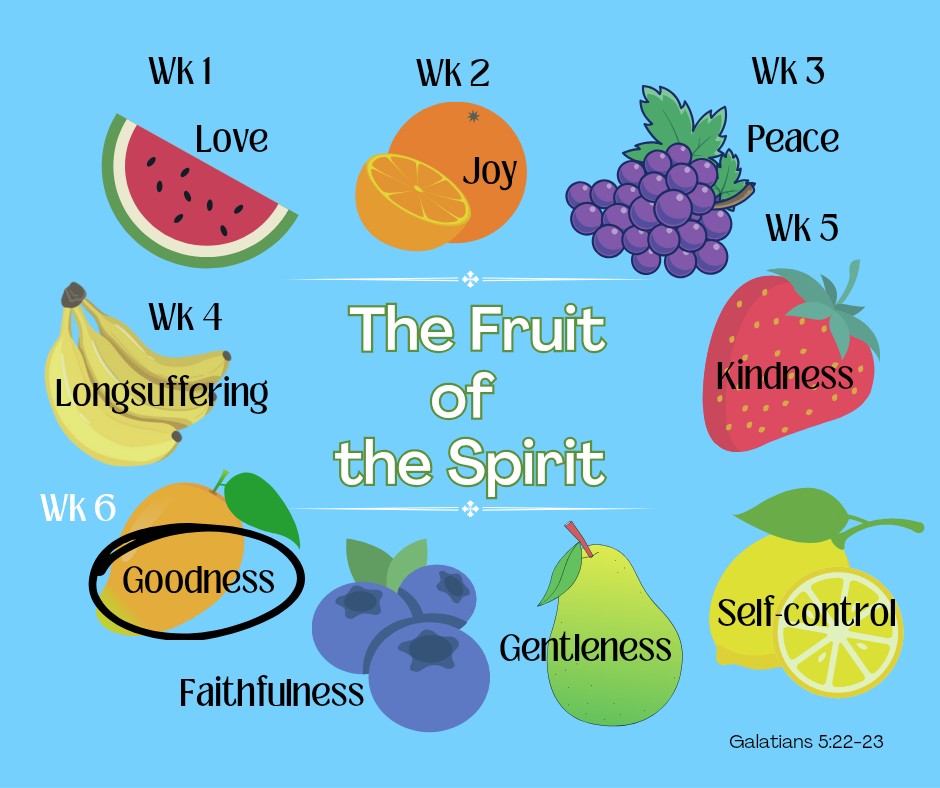


Week 4 Fruit of the Spirit: Longsuffering (Patience)
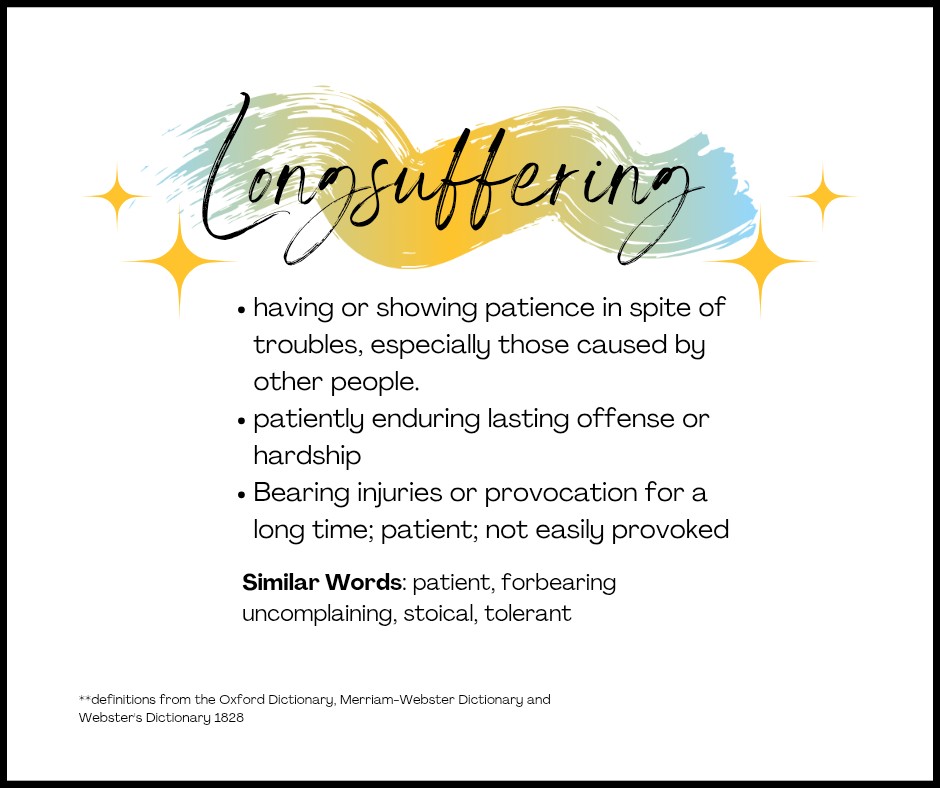


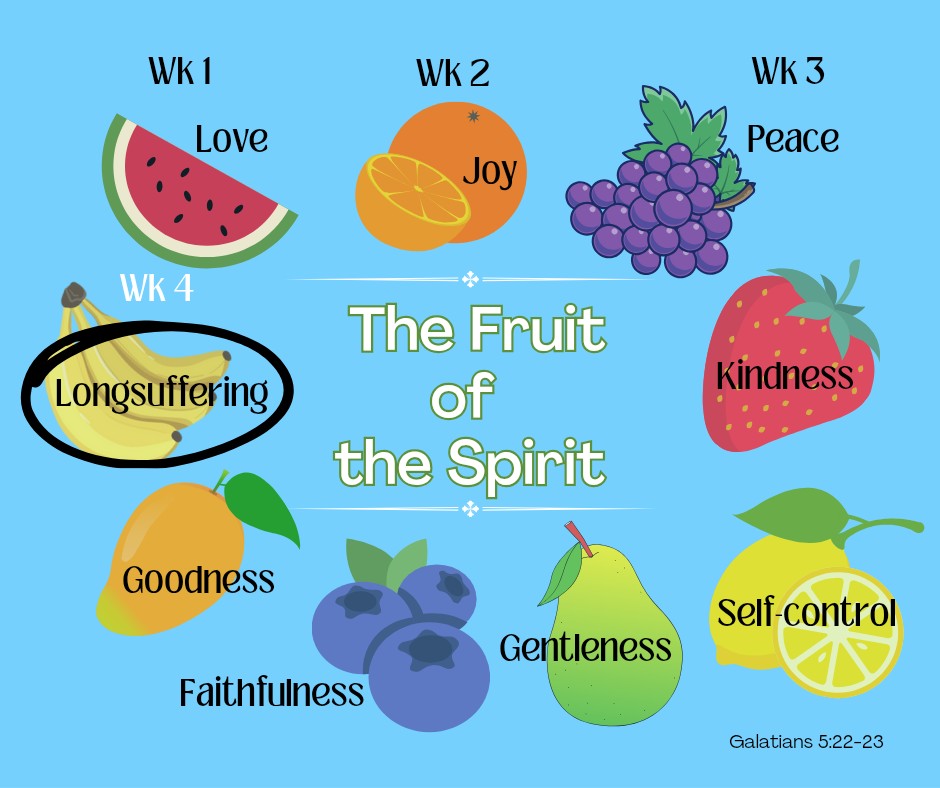
Hello everyone!! We have been journeying through the fruit of the Spirit for the past 3 weeks. So far, we have explored love, joy, and peace. Today, we will discuss longsuffering (patience) and how we can patiently endure as believers. Additionally, we will explore how it is intertwined with fruit from the previous weeks: love and peace. Oftentimes, we see the fourth fruit of the Spirit labeled as patience. But I am choosing to use the King James version, which lists it as longsuffering. I have included definitions of the term so we have the correct understanding of the word. In my own words, I would describe longsuffering as being an enduring type of patience through the troubles and hardships of life. It is persevering and not easily angered, even when faced with difficult people or circumstances. I will break down what we need to patiently endure. This is not an exhaustive list but some suggestions that will help you. It’s divided it into five areas: (1) genuine love for one another, (2) the desire to maintain peaceful relationships, (3) forbearance with others, (4) the decision to walk in forgiveness, and (5) slow to anger.
What We Need to Patiently Endure
Genuine Love for One Another
To patiently endure as believers, we need genuine love. Love that is fake and forced will not enable us to exercise longsuffering. Rather, it will cause us to continually look for reasons or excuses of why we can not walk in love with one another. But in Romans 12:9, it emphasizes the necessity for our love to be sincere. We must confront and resolve any problems we have with displaying love if we truly desire to be longsuffering. As followers of Christ, we are commanded to love one another. It is not a suggestion but a requirement for all who are born again believers. We can not afford to walk around with hate, resentment, bitterness, or strife in our hearts. We must look to our Father to examine our hearts in order to get to the root of what is hindering us from genuinely loving others. When He reveals what is in our hearts, we should be intentional in resolving it rather than pretending everything is fine. We can seek His guidance in working out the issue. We don’t have to do it in our own strength. When we are truly repentant, sorrowful of what is hidden in our heart, He helps us in the matter. Through the leading of His Spirit, we are able to rectify the wrong and put things in Godly order, enabling us to walk in genuine love.
The Desire to Maintain Peaceful Relationships
The next area that is necessary for believers to patiently endure is having the desire to maintain peaceful relationships. When our aspiration is to have peace within our relationships, that is half the battle. It is a matter of having the right mindset. We can have a mindset of peace and unity or one of strife and discord. Everyone doesn’t have the same way of thinking pertaining to our interactions with each other. Some people thrive off drama and chaos. They immaturely live to meddle in other people’s lives and stir up mess. Others who are mature, operating with Godly wisdom genuinely pursue peaceful relationships. In Psalm 34:14, we are instructed to seek peace and pursue it. As believers, we should be peacemakers, not sowers of discord, strife, and division. That behavior goes against how we are called to live. When we maintain peace with others, it enables us to exercise longsuffering. If our focus remains on peace, we can endure through the difficult times in our relationships with others.
Forbearance with Others
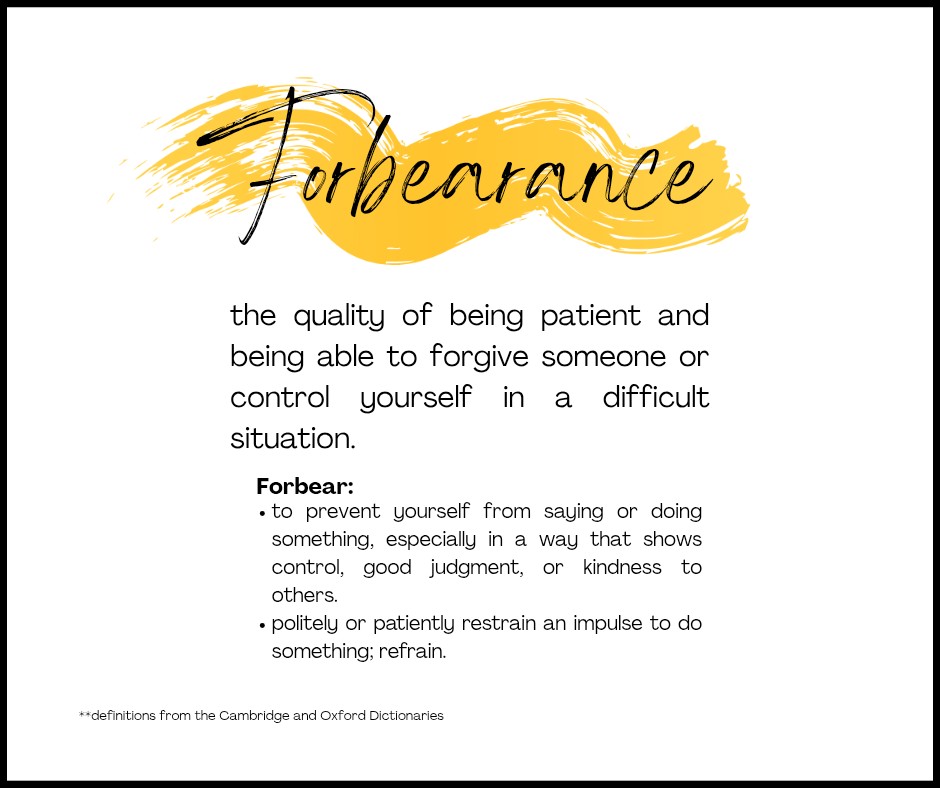

The third area that is instrumental in believers exercising longsuffering is forbearance. As believers, we need to be able to patiently restrain ourselves in difficult situations. There are times that test our character and our ability to exercise self-restraint. When they come, we may be pushed to our limit. We will have to face challenging situations with others that force us to exercise restraint in spite of the person looking for a reaction desiring to pull us out of Godly character. When we choose to operate in forbearance, we are not reactive to instigators, agitators, and arguers. With the assistance of the Holy Spirit, we are able to sustain our character while working toward maintaining peace, if possible. Also, in being forbearing with one another, we do so in love. It requires walking in genuine love to choose peace and to deal with others in patient self-restraint during trying circumstances. With forbearance, it leads to the need for us to walk in forgiveness as believers.
The Decision to Walk in Forgiveness

In this area, it takes each of us making a mature decision to forgive. We will have circumstances where we are provoked either intentionally or unintentionally. If we choose to walk in unforgiveness, it restricts us from being able to love authentically, and likewise, we may not desire to pursue peace with others. Staying in a state of unforgiveness prevents us from operating in longsuffering when we face challenges and hardships. Just as we are required to love one another, the same applies to forgiving others. If we hope to patiently endure, we can not ignore the need to forgive. Walking in unforgiveness is a major hindrance in our lives that has dire consequences that are often overlooked. If we choose not to forgive others of their faults (whatever they have done or said to us), God will not forgive us of our sins. No matter what conflict or offense has occurred, we need to forgive. It is not excusable for us to stay in unforgiveness as believers. We must forgive and release them to God. It is our responsibility to forgive and let YAH handle the rest. We can not be vengeful and look to repay evil with evil. We must release them to the Father. Forgive, release, and let YAH handle the rest.
Slow to Anger


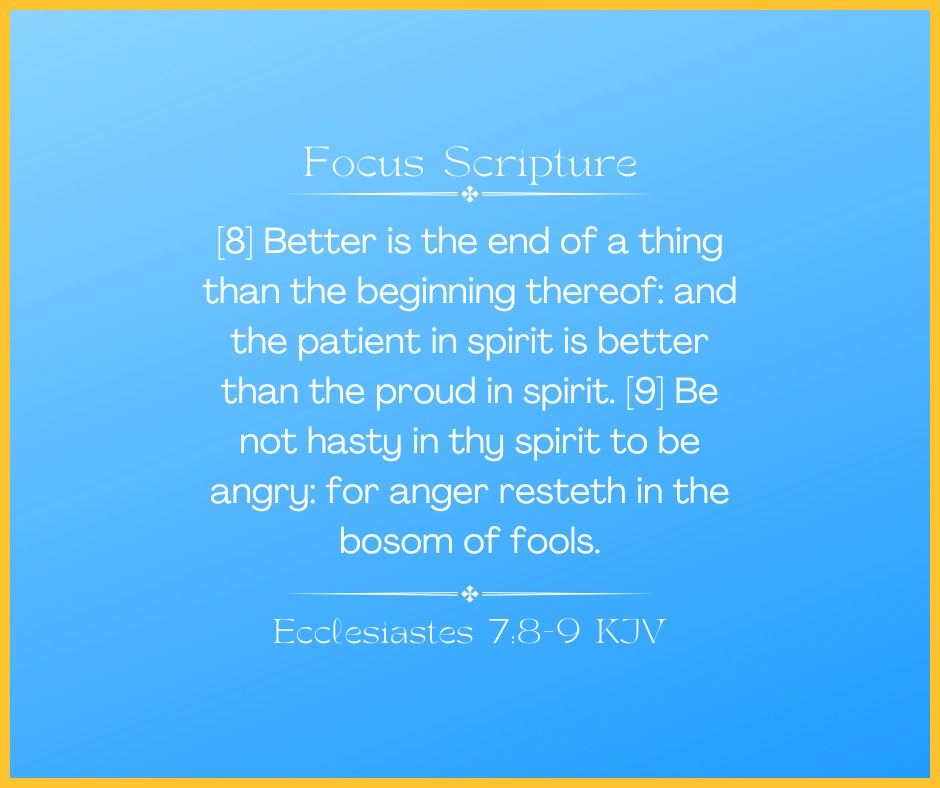
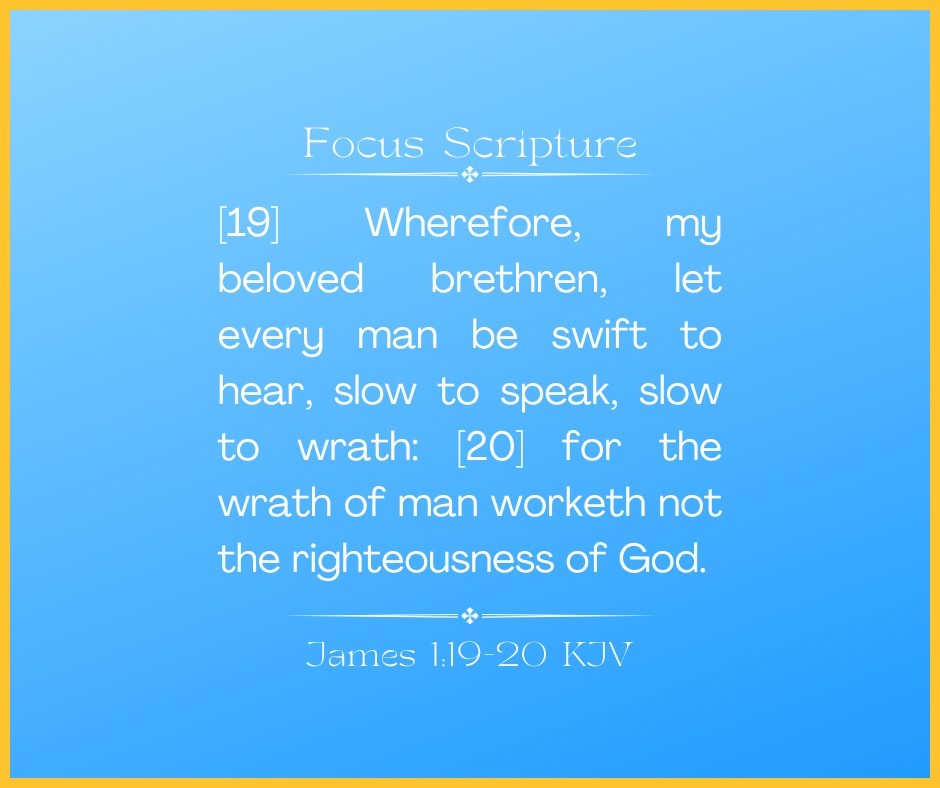
In the last area, our Father models for us being slow to anger. We should not be hot-headed, quick-tempered people. Throughout the scriptures, we are instructed to be slow to anger and to rule over our spirit. In life, we will face troubles, hardships, and people that cause us to become angry. It is unrealistic to think we will never be angry. But the difference is, as believers, we should not be easily provoked to anger. Both minor and major conflicts, disagreements, or inconveniences with others should not lead us to a place of being enraged or wrathful. We shouldn’t be overtaken by anger. Ephesians 4:26-27 says, “²⁶ Be ye angry, and sin not: let not the sun go down upon your wrath: ²⁷ neither give place to the devil.” To be longsuffering, we must be slow to anger. We should follow James’s instructions and be quick to listen, slow to speak, and slow to wrath. I have looked at James 1:19-20 as reminding believers to listen twice as much as we speak. We have two ears and one mouth. Listen more, talk less. If we take the time to hear and understand what the person is saying, it will help us to be less reactive, argumentative, and defensive. We need to use Godly wisdom not to become reactive when challenges arise or when we have to deal with difficult people. Remain calm, listen to understand, and then address the situation/person with maturity and a level head.
Recap
What is Needed to Patiently Endure
- Genuine Love for One Another
- God models how we are to love. (Agape love)
- Sacrificial, selfless unconditional love
- Let our love for others be sincere, not fake or forced.
- God models how we are to love. (Agape love)
- The Desire to Maintain Peaceful Relationships
- Seek and pursue peace with others
- As believers, we are called to be peacemakers, not sowers of discord, strife, and division.
- Forbearance with Others
- Patiently restrain (control) ourselves in the midst of challenges
- Don’t become reactive, but maintain our peace. (Stay calm, cool, and collected)
- Forbear with one another in love
- Patiently restrain (control) ourselves in the midst of challenges
- The Decision to Walk in Forgiveness
- It is up to each of us to choose if we will walk in forgiveness or unforgiveness.
- Staying in a state of unforgiveness prevents us from operating in longsuffering when we face challenges and hardships.
- When we forgive, release the person, and let YAH handle the rest. (Forgive, release, and give it to God)
- Slow to Anger
- Learn from YAH’s example of being slow to anger.
- During a conflict or disagreement, be quick to listen, slow to speak and slow to anger.
- Two ears and one mouth: Listen twice as much as you speak
- Listen to understand, not just to respond
Think About It: Personal Reflection
- Am I exercising longsuffering in my life regarding my relationships with others?
- Are there areas in my life God is stretching me to have a greater ability to patiently endure?
**Scriptures used from the authorized King James Bible
Next Week’s Blog



Week 3 Fruit of the Spirit: Peace
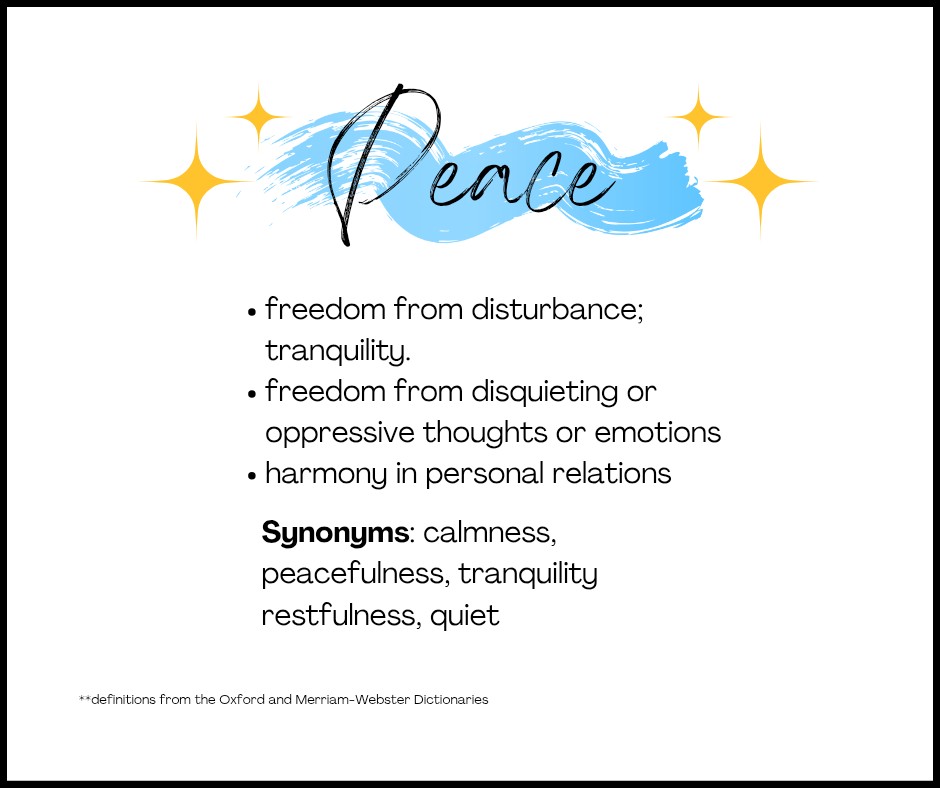
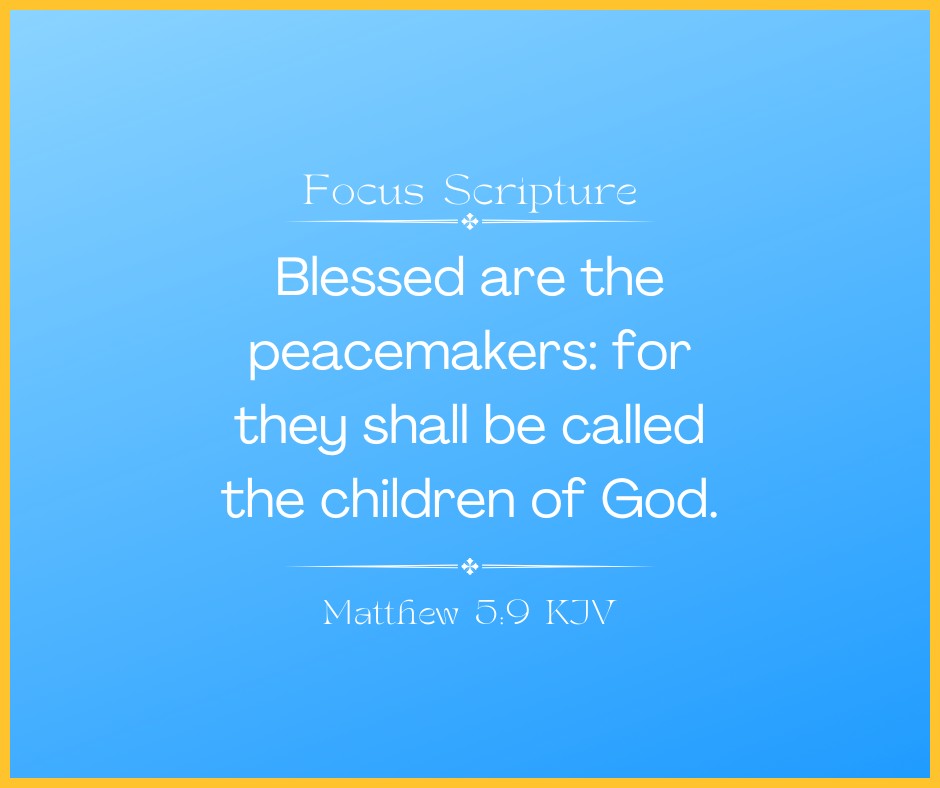

Hello everyone!! This is the third week of our fruit of the Spirit discussion. So far, we have explored walking in love and joy. Today, we will discover how we can be intentional in living a peaceful life. It does take work for some of us more than others. But no matter how difficult or easy it may be, it is necessary for us to be peaceful people. Two areas that are vital for each of us to be peaceful people are understanding that we first must be loving and, two, have a greater dependency on the Holy Spirit. Genuine, not fake, love is needed to have peace. Walking in peace is easier to do when we truly love one another. Also, when we have difficulties or issues arise, we can lean into the Holy Spirit’s guidance on how to maintain peace. Conflicts, whether great or small, can cause breaches in our peace with one another. But we are responsible for being peacemakers, not to harbor any ill-feelings further causing a strain in our relationships. In the above scripture, Matthew 5:9, Jesus is talking with his disciples and discussing the beatitudes. He says those who are peacemakers are blessed and will be called children of God. We are not to be arguers, agitators, or instigators, but as God’s children, we are peacemakers. Additionally, Psalm 34:14 reminds us to seek peace and pursue it. We should make every effort to live in peace, not involving ourselves in trivial disputes or divisive behaviors that further causes conflict. If we claim to be children of the Most High God, we should walk in peace.
In today’s blog, we will explore: having inner peace, living peacefully with others, behaviors that hinder us from walking in peace, and leading by example.
Inner Peace comes from YAH

In order to walk in peace with one another, we must have inner peace. We can not give others what we do not have within ourselves. The inner peace that believers exude comes from YAH. Peace from any other source is a counterfeit and temporary. But perfect peace comes from our Father. When our mind remains on God and we trust in Him, we are able to have peace that sustains us. In spite of the inconveniences, issues, or conflicts that arise, we can remain calm, cool, and collected. We have an inward resolve that gives us the ability to stay peaceful even when circumstances or people want to pull us out of our Godly character. It is important to understand that we will experience times that come to test our capacity to maintain our peace. And, it is up to each of us to handle the situation the right way. During those intense moments, if we are still enough, we can sense the Holy Spirit helping us navigate those times. He will allow us to maintain our inner peace regardless of the outside sources trying to threaten it. The beauty of our walk with Christ is that we have Godly assistance. The same way God has modeled love and has given us joy, He will continue to strengthen us and provide us with the peace we need.
After we have obtained inner peace from our Father, it enables us to more easily walk in peace amongst others.
Living Peacefully with Others


The scriptures listed above show us the importance of believers living peacefully with others and being intentional to pursue after it. We must display maturity. When we are interacting with others, there will be times we disagree or issues arise within our relationships. But it takes two mature individuals to work through any problems to maintain peace within the relationship. There are occasions in which one person may be willing to discuss the matter; but the other person isn’t. Instead, he or she is resistant to talk it through in order to clear up the issue. On both ends of the matter, each person must be open to working through the disagreement or conflict. Disagreements will happen, but how we navigate them has a huge impact on our ability to come to a peaceful resolution. A disagreement does not have to become an argument. No one’s point of view is understood when one or both parties are shouting to get their point across.
That reemphasizes the need for inner peace, so when a disagreement arises, it does not turn into a shouting match with no resolution in sight. We need to remain calm even when we are tested by others during emotionally intense situations. We can not solely look at it from a surface level. We must be mature enough to understand that when problems arise, it is not always the person but a spirit in operation within them trying to cause division in the relationship. That is why we need the guidance of the Holy Spirit to help us navigate these situations. When we do so in our own strength, our flesh gets in the way, and it can cause more harm than good. So, we need to allow the Holy Spirit to help us in these areas of conflict management to ensure we can come to a harmonious resolution if possible.
There may be circumstances where we are intentional in seeking peace after conflict; but the other person may have no interest in reconciling. Romans 12:18 makes allowance for that. We are instructed that if it is possible as much as depends on you to live peacefully with all people. That shows us there will be times that we may not have peaceful relations due to the other party’s unwillingness. But if we can, maintaining peaceful relations should be our first desire.
Behaviors that Hinder Us from Walking in Peace

As we are pursuing a peaceful lifestyle, we must have the awareness that there are behaviors that hinder us from walking in peace. Living a peaceful life requires us to operate in Godly wisdom. In doing so, it will help us to avoid behaviors that further bring conflict and division in our relationships. I want to share some that serve as hindrances. Believers should not be contentious. That means we should not be people who are likely to cause a disagreement or argument. Nor should we exhibit an often perverse and wearisome tendency to quarrels and disputes. Simply put, we should not be the cause or instigator of arguments and disputes. Operating with contention contradicts walking in peace. Throughout the Book of Proverbs, we are warned about displaying contentious behavior and how it negatively affects relationships.
James chapter 3 warns us of the consequences of operating with ungodly wisdom; it is earthly, soulish, and devilish. No good comes from this type of wisdom. The passage of scripture emphasizes how detrimental it truly is. We are given the warning that where there is envy and strife, there is confusion and every evil work. As believers, we should not behave in a way that is envious, nor should we be full of strife. These two behaviors will cause us to be at odds with people we are called to love and be at peace with. We should find contentment in what we have rather than comparing ourselves to others, allowing envy to take root in our hearts. Additionally, we should not allow a minor issue turn into a bitter or angry disagreement (strife). Before it causes a major riff in the relationship, it needs to be addressed, having a level-headed conversation. When two hot-headed people try to have a reasonable discussion, it can be like adding accelerant to a fire. Nothing good comes from it, just more possible damage. It is very likely that no one is going to clearly hear what the other has to say. There would be too many emotions involved, and instead of being led by the Spirit of God, both would be led by their flesh.
Lastly, one major behavior that prevents us from walking in peace is immaturity. It takes maturity to have a respectful and honest conversation with the goal being a peaceful resolution. We have to get over the notion of having to be right and prove our point to the other person. That solves nothing. You may not always be right. Rather, the end result should be lovingly making amends coming to a resolution that is beneficial and healthy for both parties. Immaturity will prevent us from actively listening to what the other person is saying. Instead, we have to be quiet enough to listen and comprehend what is being said. We are not listening just to respond and defend ourselves. That’s why it is necessary to have a discussion when both parties are sober-minded, not amped up full of emotions. Otherwise, that can just result in a shouting match. In those moments, we need to give ourselves time to cool down, relax, and let the Holy Spirit lead us in our discussion. It all goes back to allowing the Spirit of God to lead us, not our flesh. Our flesh will only bring more division and strife, creating a further wedge in the relationship.
Leading by Example

In this last area, I want to emphasize the importance of being an example before unbelievers of how to live a peaceful life. We must recognize that as believers, those who are unsaved are observing how we live. Our life is on display for them to see. We can not proclaim one thing while living another way. The way we behave can either give a Godly example or a lukewarm-compromised example. It is up to each of us to make the decision.
In I Thessalonians 4, the apostle Paul instructs the church of Thessalonica to aspire to live a quiet life, mind your own business, and work with your own hands that they may walk properly. This passage shows us how vital it is to live a Godly, peaceful life before others. The way we live should be a positive reflection of who we belong to. There should be a noticeable distinction in believers when the world observes our lifestyle.
To make it relatable in today’s society, we should not live chaotic lives full of drama and discord. We should not meddle in other people’s affairs. Instead, we should take care of matters pertaining to ourselves and our home. While the world feeds off of sin, pettiness, and relational drama, our behavior should reflect Godly character. As believers, we are responsible for presenting a Godly example for the world to see.
RECAP
- Inner Peace
- Comes from YAH
- Walking in peace starts inwardly
- Living Peacefully with Others
- Seek peace and pursue after it.
- If it is possible, as much as depends on you, live peaceably with all people. (Romans 12:18)
- Behaviors that Hinder Us from Walking in Peace
- Contention
- Strife in words or debate; quarrel; angry contest; controversy
- Envy
- A feeling of discontent or covetousness with regard to another’s advantages, success, possessions, or qualities
- Full of strife
- Bitter sometimes violent conflict or dissension
- Immaturity
- behavior that is not as calm and wise as people expect from someone of your age
- Pettiness, drama, etc.
- Contention
- Leading by Example
- As believers, we should be the example for unbelievers of how to live a peaceful life.
Think About It: Personal Reflection
- Am I intentional about living a peaceful life, or does my life thrive off of drama and discord?
- Do any of the relationships in my life have strife and division? Is it possible to make a peaceful resolution with the other person(s)?
- What example am I displaying to unbelievers? Does my behavior reflect Godly character, or is it lukewarm and compromised?
**Scriptures used from the New King James Bible and the authorized King James Bible
**Definitions used from biblehub.com, the Oxford, Merriam-Webster, and Cambridge Dictionaries
Next Week’s Blog


Week 2 Fruit of the Spirit: Joy
Hello everyone!! This is week two of our discussion on the fruit of the Spirit. Last week, we went over walking in love. By exploring I Corinthians 13:4-8a, we discovered what love is and what love is not. In John Chapter 13, we saw Jesus’s commandment for us to love one another. Additionally, we were given the model of agape love by our Father. We understood that YAH is our standard for love. We recognized Christ’s sacrificial love in which He willing laid down His life for us. And, through faith in Him, we receive eternal life. Lastly, we recognized the importance of genuinely loving one another, not solely with our words but to follow through with our actions. No lip service, but loving each other sincerely.
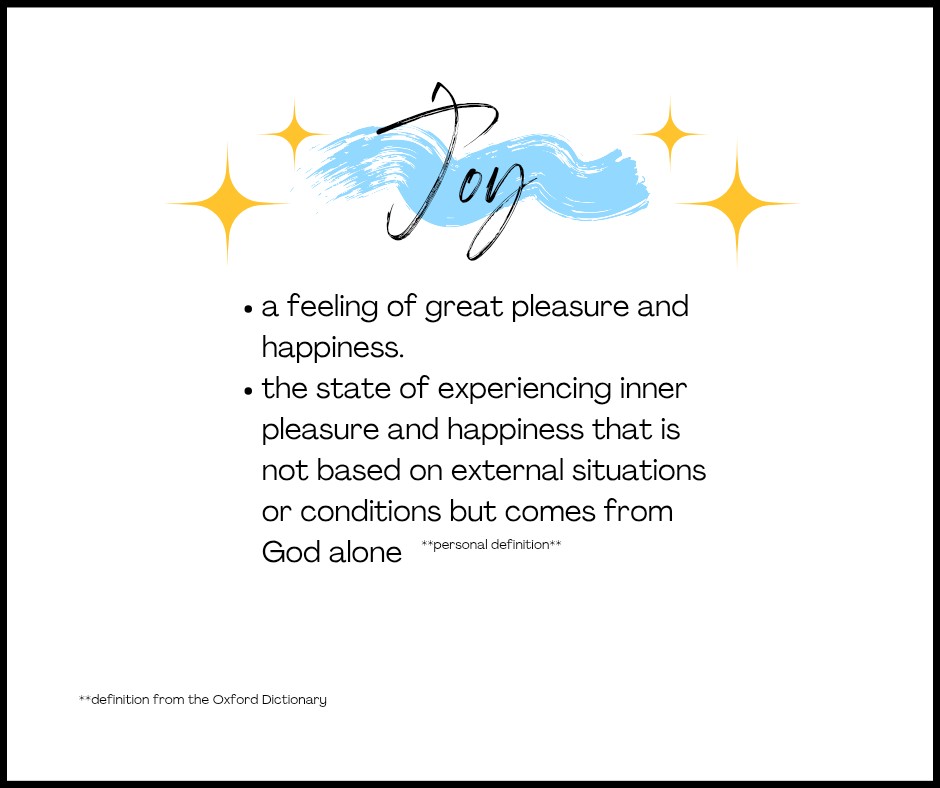
Today, we will explore the second fruit of the Spirit: joy. When we experience joy, it is more than a temporary happy feeling. In the biblical context, it can be defined as a profound and abiding sense of happiness and contentment that is rooted in spiritual realities rather than temporal circumstances. In order to walk in joy, we will discuss three areas in which we experience joy: inwardly, expressively to God, and in our interactions with others.
Inner Joy


The first area we experience joy is inwardly. It starts within our hearts. The condition of our heart affects our ability to walk in joy. The trials and hardships of life can attempt to rob us of the joy we have. Nevertheless, we must choose to walk in joy regardless of those experiences. It requires us to exercise maturity to choose joy over despair. Challenges and hardships will come; that is expected in life. It is up to each of us to choose our response when they do come. We can make the decision to stay in a place of defeat wallowing in hopelessness and discontentment. Or, we can choose to put our hope in YAH, experiencing joy despite the unpleasant conditions of life. We must have an inward resolve to put our trust in our Father. When things look bleak and we become discouraged, we have the reassurance that God is our hope. When our circumstances seem unstable, we can find peace and stability in knowing our Father remains consistent. He never changes, and He will not fail us. We can rest in the fact that we are covered by our Father, and regardless of the circumstance, He is with us. He has not left us nor forsaken us. This is a decision we have to make daily. Our adversary, the devil, would like more than anything for us to walk around depressed, defeated, and hopeless due to the trials we face both great and small. So we must overcome those feelings and walk in true joy that is unshakeable because it comes from YAH.
Another reality we must confront as believers is persecution. Whether on a large or small scale, we will experience it. According to 2 Timothy 3:12, it lets us know that all that will live godly in Christ Jesus will suffer persecution. Persecution is unavoidable if we truly live a godly lifestyle in Christ. Instead of dreading the possibility of it, our Savior lets us know to rejoice in it. The persecution and evil words spoken against us, for His sake, let us know we are on the right path. It is all a part of living a righteous lifestyle. The fact that we are experiencing it reassures us of the great reward awaiting us in heaven. So we must endure persecution with gladness, believing that Christ will give us the strength we need in the midst of it.
When trials and persecution come a remedy to maintain our joy is having a posture of gratitude. When we have a heart of thanksgiving, remaining grateful for all that God has done, our focus is shifted from our circumstances to the goodness of God. During life challenges, it is the perfect time to reflect on our history with God and how He has continually sustained us. In doing so, this allows our perspective to shift. Where we previously felt helpless and were in a state of despair, we now have hope and joy in our Father. This is why we must maintain our posture of gratitude toward our Heavenly Father no matter the condition of our lives. This leads us to the next area, expressive joy.
Expressive Joy



With this type of joy, it is an outward expression of what we are experiencing inwardly. The inner joy we have is now witnessed through our actions. Often, the joy we have in God becomes visible in our praise and adoration to Him. The way in which we offer praise reflects the joy we have or the lack thereof. With joyful praise, it is not forced or coerced. We do not need assistance in encouraging us to give praise that is due to our Father. Instead, it flows from a genuine place within our hearts. In the Book of Psalms, the various authors, especially David, clearly articulate their dependency and hope in YAH. Within a particular psalm, it may start with the author focusing on the opposition he is facing and how it is overwhelming. But throughout the psalm, there is a shift in his focus, and he puts his attention on God, exalting God rather than the circumstance. The Book of Psalms gives us plenty of examples to mirror in our daily lives. We may not experience the same situations as the author, but it shows us the importance of having hope and dependency in our God. In maintaining our hope in YAH, we can have joy even in the midst of trials and hardships.
We can use Psalms to remind us to praise God in the midst of challenging times, not waiting until we have overcome the difficulty. When we choose to praise our Father rather than exalting the challenge, we can experience joy. As we are offering praise that is due to our God, we are strengthened, and our focus is on YAH rather than whatever is threatening our joy. What once caused despair, we now have the ability to endure through it because we have joy that comes only from God. We are able to express our joyful adoration in the way we choose to praise God.
Joyful Interactions with Others

The last area in which we can walk in joy is our interactions with others. The inner joy we have should be expressed to those we do life with. If we are operating in true joy, not just temporary happiness, it will be expressed in our engagement with each other. This can not be faked. In the same way we are to genuinely love one another, we should seek to joyfully interact with others. In Acts 2, we witness how the newly converted believers interacted amongst one another. The scripture details that in their interactions, there was unity and togetherness. It depicts a group of people who truly love and enjoy communing with each other. What’s understood is that they are joined together in Spirit. They all may not have been blood-related in the natural. But they now were spiritually related joined togther by their faith in Christ. They all belonged to the same spiritual family, the body of Christ. Unlike natural families, this family was bonded together by the blood of Jesus. It was the believers’ faith and oneness of Spirit that enabled them to have these joyful interactions.
Final Thoughts
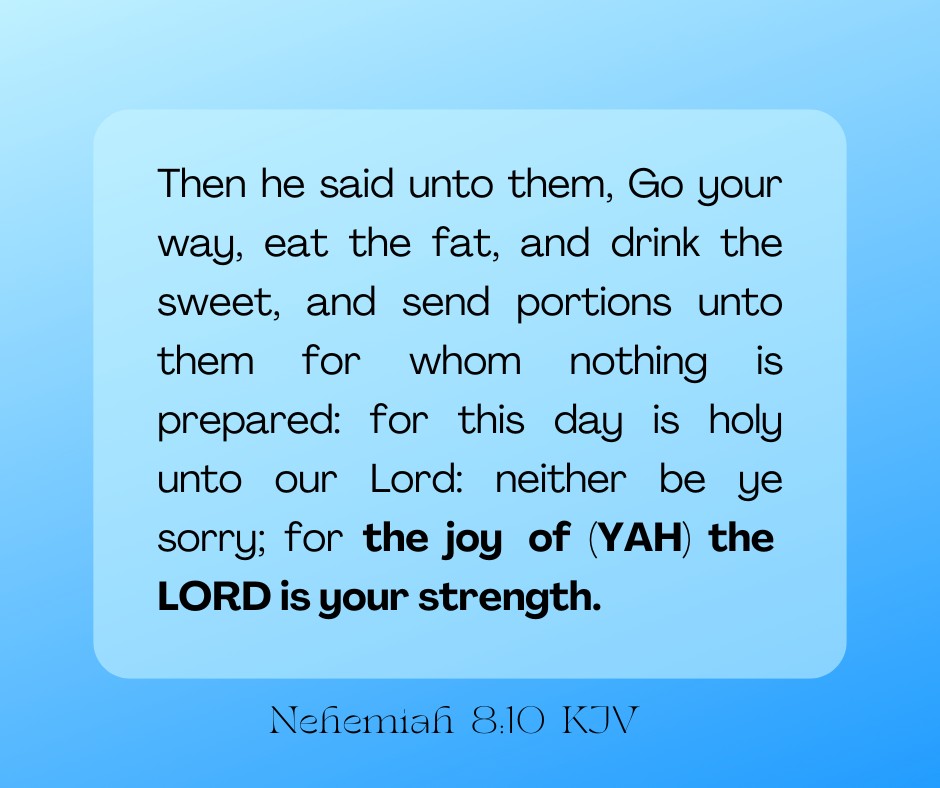
One final thing I want to remind you of is that the joy of YAH is your strength. No matter what you may experience, remember He is present with you. Put your hope in Him, and He will endow you with His joy, helping you to endure the trials and hardships that come your way. It is His joy that will allow you to still offer praise even in the midst of your greatest challenges.
Think About It: Personal Reflection
- Am I walking in joy or just experiencing moments of happiness?
- Are there any threats to my joy that I need to confront head-on?
- What do I need to adjust to genuinely walk in joy?
**Scriptures used from the New King James Bible and the authorized King James Bible
**Definitions from the Oxford Dictionary and biblehub.com
Next Week’s Blog
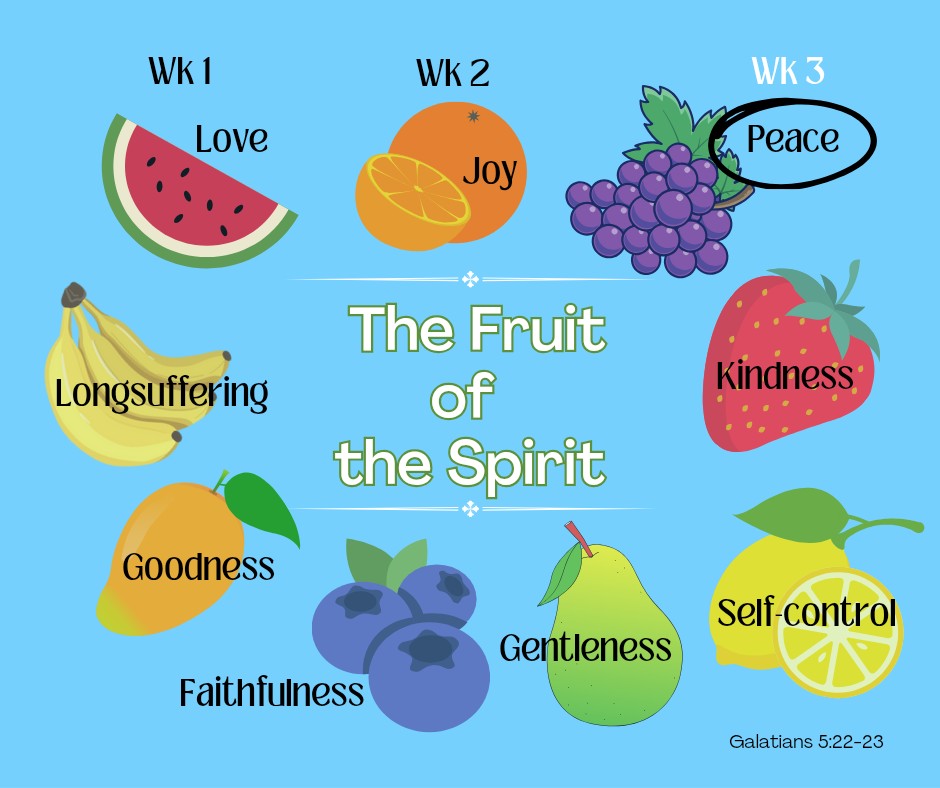


You must be logged in to post a comment.