
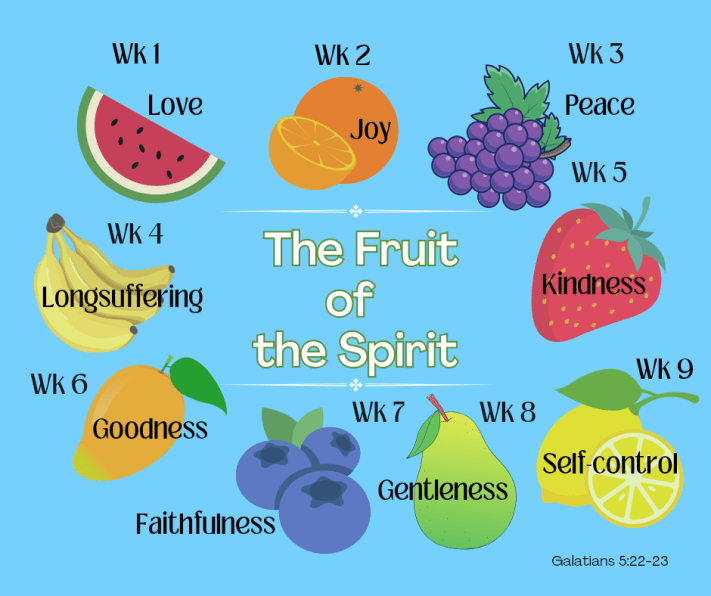
- Week 1: Walking in Love
- Week 2: Walking in Joy
- Week 3: Living a Peaceful Life
- Week 4: Patiently Enduring as Believers
- Week 5: Extending Kindness to Others
- Week 6: Seeking to do Good Toward Others
- Week 7: Remaining Faithful as Believers
- Week 8: Walking in Gentleness
- Week 9: Exercising Self-Control
Tag: Self-control

Week 9 Fruit of the Spirit: Self-Control (Temperance)


We’ve made it to the final week of our discussion on the Fruit of the Spirit!! 🎉🎊🎈I hope you have enjoyed this time of exploring each fruit. If these posts have been helpful to you, please share them with others. This topic is beneficial for all believers whether you are newly converted or have been saved for many years. In our journey as followers of Christ, it’s important that we walk in the Spirit. When we do so, we will not fulfill the flesh’s lustful desires. We must have the awareness that what our flesh desires is contrary to what the Spirit desires. The two war against one another. As believers who walk in the Spirit and are led by the Spirit of God, we are able to produce spiritual fruit. In John 15, Christ lets us know He is the True Vine and his followers are the branches. When we, the branches, remain in fellowship with Him, we are able to bear fruit. But if we are separated from Him, we are unfruitful. In everything that has been discussed, I pray that you will be reminded of that fact and stay connected to the One who enables us to bear fruit.
In today’s blog, we will go over what self-control means and examine how we can exercise it our lives when overcoming temptation and in difficult situations.
Understanding Self-Control
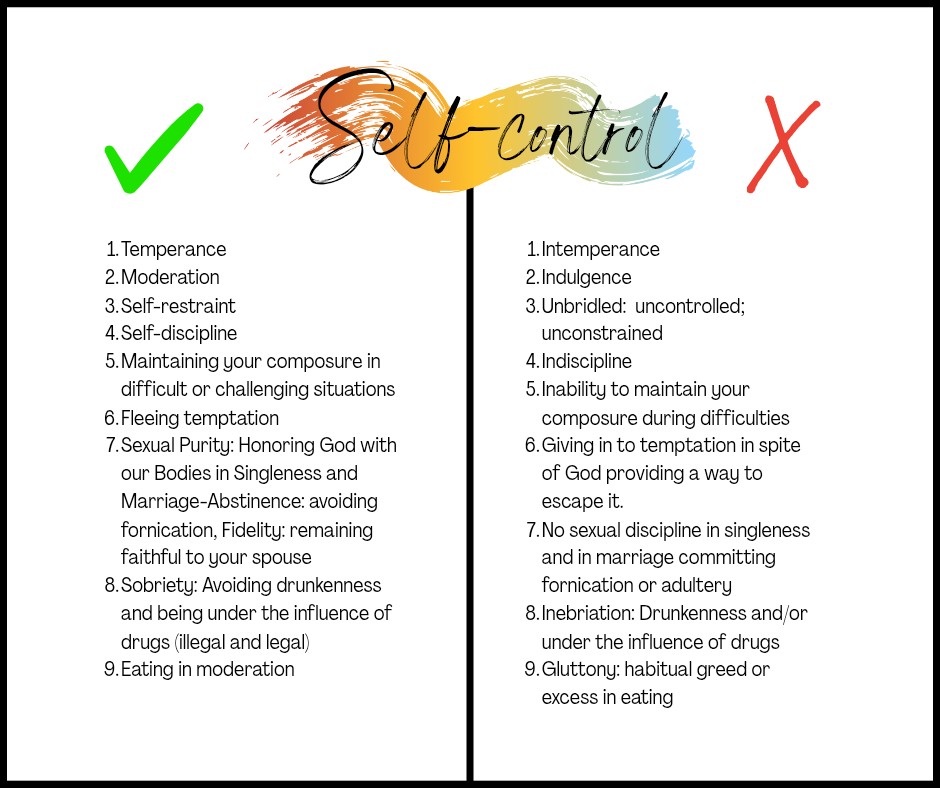
Self-Control is…
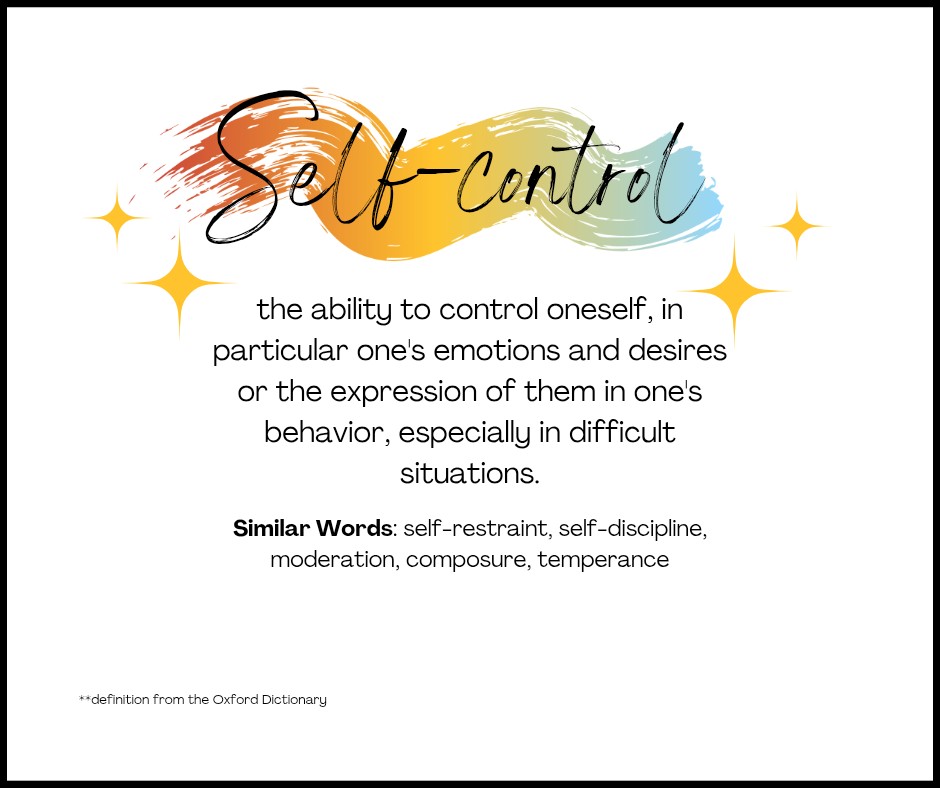

Self-Control is not…

Examples of Self-Control
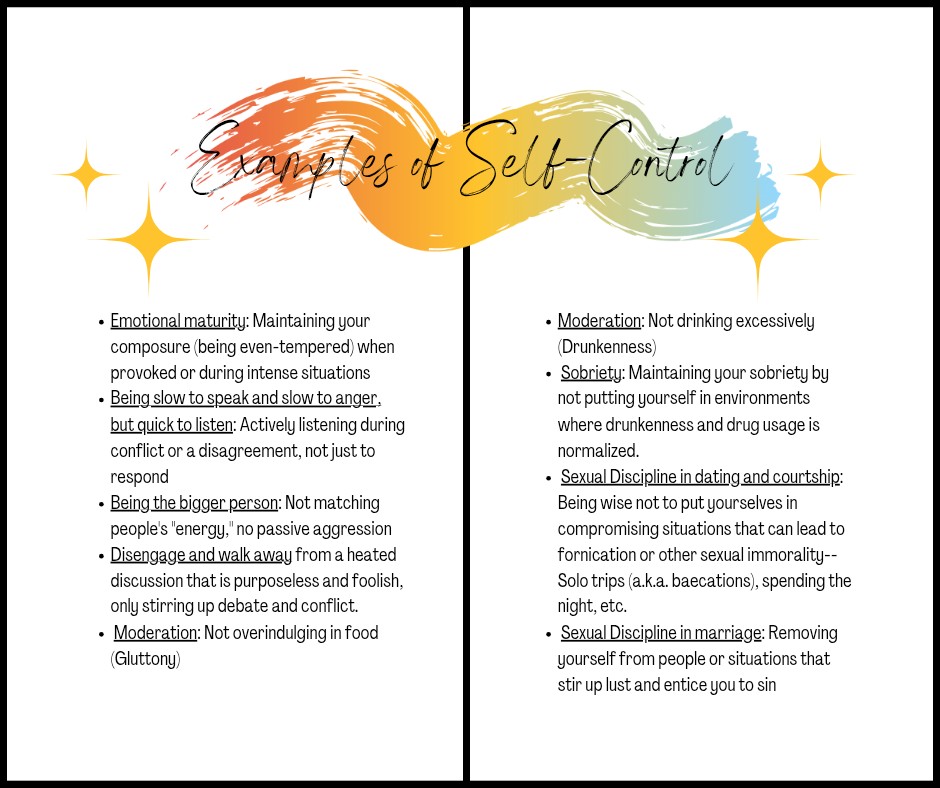
Overcoming Temptation and Exercising Self-Control
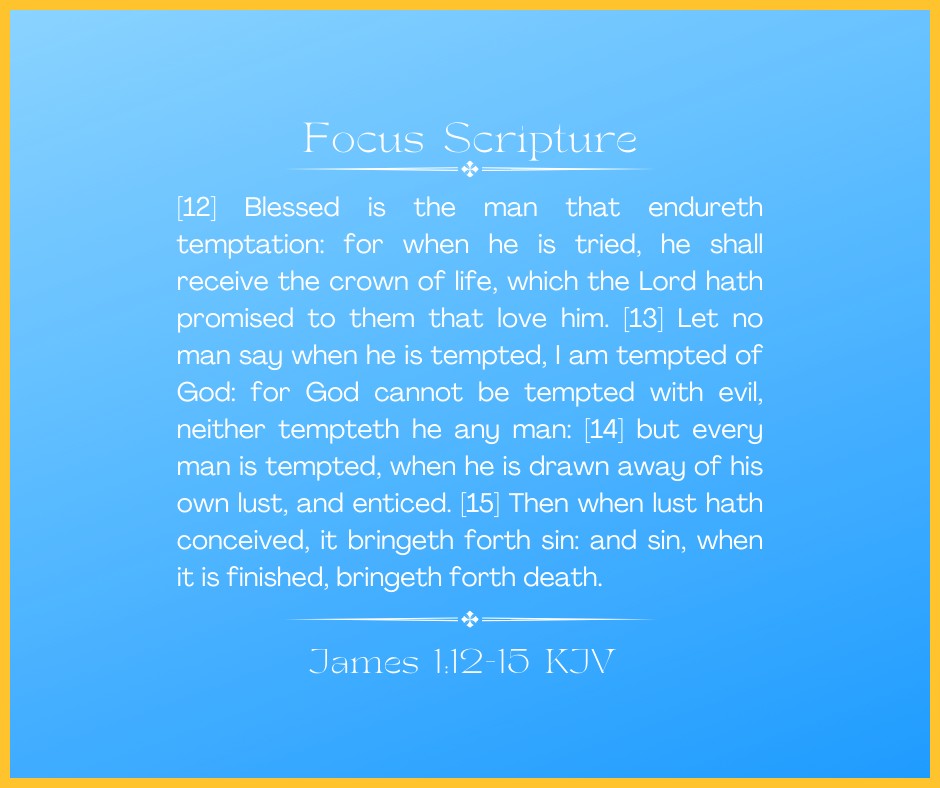

When we are mindful of the situations and places we put ourselves in, it will help deter us from falling into temptation. If we are maintaining a lifestyle of sobriety, it wouldn’t be wise to hang around people who live an ungodly lifestyle ruled by alcohol and drug usage. That would be counterproductive in having a set-apart lifestyle. That’s why it is important to CHANGE YOUR ENVIRONMENT. When what had you bound is readily accessible, it makes it easier to return to your bondage. But when you are in a new environment, free from your former vices, it helps to prevent you from going back to alcohol and drug usage.
Another area to overcome is sexual temptation. This area is for both single and married believers. It doesn’t discriminate based on marital status. Whether you are married or single, the enemy will bring temptation to lead you to sin. As believers, we must address anything that threatens our sexual purity. For those who are single, we must be more aware of what we receive in our lives that stirs up lust and can lead us to engaging in fornication or other types of sexual immorality. It’s important to examine the people in our lives: who we associate with, who we call friends, and who we are dating/courting. We should ask ourselves: Are we equally yoked in these relationships? Or, do they cause us to be tempted to sin? Do they indulge in the activity that we are intentional about abstaining from? Are they a stumbling block in our journey of walking in purity?
These are just some questions to consider when examining the associates, friends, and romantic partners in our lives. Also, it’s necessary to examine ourselves so we do not serve as a stumbling block for others, tempting them to engage in sin. Our focus should not be one-sided, only fixated on others’ behavior. We need to be mindful of our conduct to ensure we are not leading anyone astray. Next, we should analyze what we receive through entertainment (TV shows, movies, music, etc.) and social media. Anything we consume on a regular basis can shape our perspective on a matter. So, we should be aware of the messages we are surrounding ourselves with.
For married believers, they can also face sexual temptation. This type of temptation is not just exclusive for the unmarried. The enemy will send his minions (as I like to call them) to sow seeds or bring about the destruction of a marriage through adultery. Some come in the form of friends and associates who sow seeds that make adultery look harmless. They justify behavior that can lead to adultery or is flat-out adulterous. These individuals do not value the sanctity of marriage and diminish the consequences that come with this sin. Also, there are Satan’s minions who serve as the temptation. They’re not the seed sower; instead, their purpose is to get you to commit adultery with them. That is why it’s crucial to be self aware of what can arouse lust in you and who around you can feed into it. Outside of your marital union, it is vital to recognize if your relationships with associates and friends are equally yoked. Otherwise, they could be harmful to your marriage and sexual purity.
Additionally, for both single and married believers, we must hold ourselves accountable for overcoming temptation. We can not solely put the blame on others. We must do our part when temptation arises in our lives. When it comes, we must recognize and flee from it. No matter how great or small, the temptation should be addressed, and we should actively look to remove ourselves from it. Temptation is not something to play with. We shouldn’t allow it to stir up lust enticing us to sin. That is why we need to recognize it and remove it from our lives. Depending on the situation, we may not be able to completely remove ourselves from it, but we should be intentional in providing a substantial amount of distance between ourselves and the said temptation. This includes matters in which we still have to work or have some basic interaction with the tempter. It would be beneficial to use Godly wisdom in these situations.
We also have the reassurance based on 1 Corinthians 10:13, that when we are tempted, our Father gives us the willpower to overcome and provide a way of escape. We can rest in the fact that when temptation arises, we are strengthened by God to overcome it. And, not only that, He will give us the opportunity to be freed from it. That is a win-win. But in order to be successful, we have to exercise self-control, not giving in to the temptation. We should be deliberate in looking for the way out that our Father will provide for us.
The third area to exercise self-control is overcoming the temptation to overeat. We can not say we have self-control if gluttony is running, or rather, ruining our lives. We can not allow food to consume our lives. We should eat to live, not live to eat. I can admit this area hit home for me. I can say there were times when I used food for comfort more than anything else. I was living to eat instead of eating to live. I was using it for emotional support, covering up the real issues I was facing. Over time, things have improved, and I am taking it one step at a time. I don’t want food to rule over me. Instead, I decided to make better food choices with healthier alternatives.
To make it applicable to each of our lives requires a change in mindset. We are not just changing how much we eat but also what we eat. Moderation is important as well as healthier alternatives. One change I’ve made is no longer deep frying my food. For certain foods, I still pan fry them; but, for the most part, I use my air fryer. If I do have something deep fried, it’s occasionally when I purchase it from the grocery store or a fast food restaurant.
Another way to exercise self-control and prevent overeating is portion control when going out to eat. This is especially helpful at buffets. Instead of piling our plates with food that we may not eat or can cause us to overindulge, we can choose smaller portions. We put enough food on our plate that we know we will finish. And if we are not full, going back for seconds only if needed. There are other ways we go about eating in moderation. But what’s important is understanding why we overeat and allowing the Holy Spirit to lead us in making better decisions that will lead to healthier outcomes. We must remember that our bodies are the temple of the Holy Spirit, and we should be responsible for taking care of them. With the Holy Spirit’s help, we can eat to live, not live, to eat.
Exercising Self-Control in Difficult Situations
In the previous section, we discussed physical actions to practice self-control. Now, we will focus on our emotional responses during difficult situations. In life, certain circumstances are unavoidable; we will face difficult situations and people. Regardless of what or who we encounter, it’s important to handle the matter the right way. As believers, we can not resort to old habits and behaviors when dealing with difficulty. We are new creations in Christ, the old has passed away and all things are made new. (2 Corinthians 5:17) Being a new creation calls for a new response to the trials and challenges of life. We are a new creation that has a new nature led by the Spirit of God, no longer ruled by our sinful flesh.
When we are spiritually renewed, our emotional reactions should reflect who we belong to. With the help of the Holy Spirit, we can learn to manage our emotions during difficulties. I’m not saying we will never have intense moments that cause us to react with emotions such as anger, sadness, or fear. Instead, when that happens, it should not overtake us. We can’t stay in the state of being ruled by our emotions. As children of God, we can bring it to our Father who will help us. He will not leave us in the condition we are in. His Spirit comforts us, and He strengthens us, giving us the willpower to endure through it. He may not always change the situation we are in; but the Word guarantees us that He will give us the ability to persevere through it. It is YAH’s wisdom that helps us navigate through the challenges and trials in our lives.
As we mature in our faith and allow the Spirit of God to lead us, our responses change and reveal a greater level of emotional maturity. When we’re able to control our emotions rather than allowing them to rule us, it shows growth. As difficult situations arise in life, we are able to express certain emotions without it taking us out of our Godly character. On our jobs when dealing with instigating coworkers who are constantly meddlesome looking to stir up drama and discord, we have to remain even-tempered and allow God to fight on our behalf. We are God’s children; we don’t match people’s “energy.” We don’t repay evil with evil. Our response to difficulties should not mirror the world’s response. When the unbeliever is eliciting a reaction from us, we should not give them that satisfaction. If dealing with a person or group of people who are disrespectful and insulting you, we don’t respond in the same manner.
We must recognize that in these situations and similar cases, it’s not wise to behave in the same manner as the world. No matter how great or small the situation may be, we are still Christ’s representatives. We can not effectively represent Him if our emotional responses are irrational, impulsive, and reckless like the world. We have to be willing to put our flesh in check. We can not afford to say what’s on our mind with no thought of the damage it does to the recipient. We are not called to “check” someone and put another person in their place. There is a difference in speaking up and addressing a matter at the right time and place. But when we do, it should be done in the right spirit, not lashing out at the individual or group driven by unchecked emotions.
As believers, when engaging with others, whether positive or negative, we should remember who we represent. We are set apart and the light of the world. How we handle conflict and difficulties should be a noticeable distinction from the world. From our emotional responses in challenging times to everyday reactions, we should reflect who we are (children of the Most High God) and who we belong to (YAH).
RECAP

**Scriptures used from the New King James Bible and the authorized King James Bible
**Definitions used from the following dictionaries: Cambridge, Merriam-Webster, Oxford, and Webster’s Dictionary 1828
Recap of the Nine Fruit of the Spirit
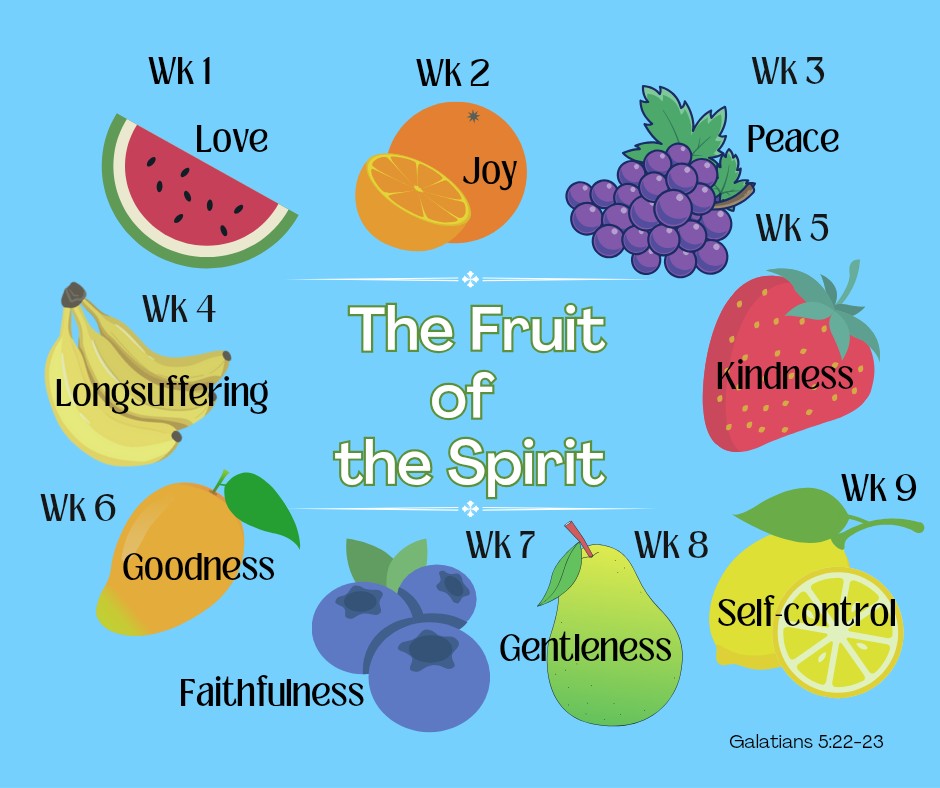
- Love: Walking in Love
- Joy: Walking in Joy
- Peace: Living a Peaceful Life
- Longsuffering (Patience): Patiently Enduring as Believers
- Kindness: Extending Kindness to Others
- Goodness: Seeking to do Good toward Others
- Faithfulness: Remaining Faithful as Believers
- Gentleness: Walking in Gentleness
- Self-Control (Temperance): Exercising Self-Control
- Current post

You must be logged in to post a comment.